Uncovering what diastasis recti is helps new mothers reclaim their core vitality after childbirth. This article breaks down the diastasis recti meaning, explores the signs of severe diastasis recti, and addresses changes in the post-pregnancy belly. Find out how expert evaluation and customised recovery plans strengthen the abdominal wall and restore functional support without invasive procedures.
Introduction: Why Does Your Core Feel Different After Pregnancy?
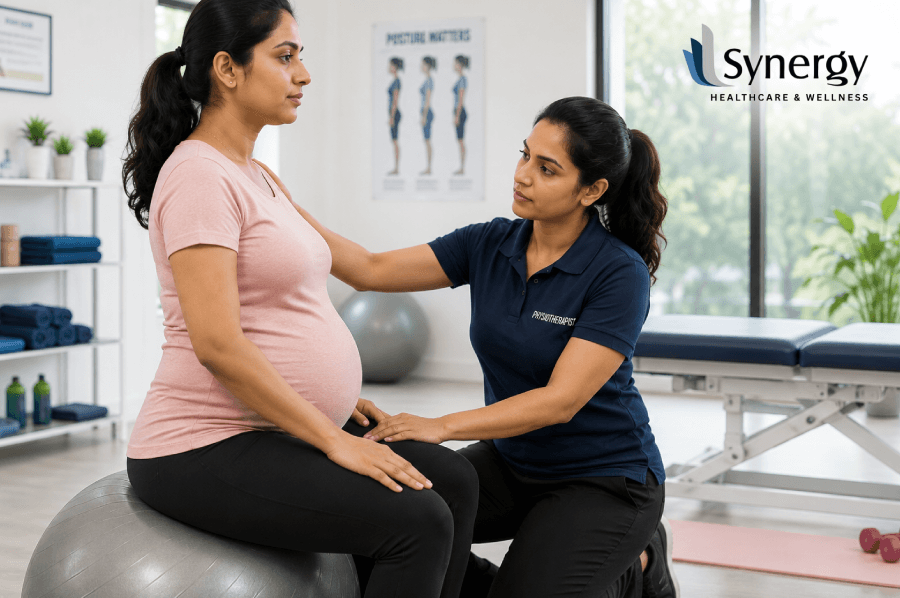
Welcoming a newborn brings immense joy, but it also introduces profound structural changes to a mother’s body. Among the most common physical shifts noticed after childbirth is a persistent softness or bulging in the midline, often referred to as a post-pregnancy belly. While many expect the abdomen to bounce back naturally, a large percentage of women experience a distinct physical condition where the parallel bands of the stomach muscles remain separated.
Understanding what is diastasis recti the first crucial step toward effective postpartum healing. It’s not just cosmetic; it’s a structural change in the anterior trunk that can fundamentally change how your body transfers weight and manages internal pressure. Discover the real diastasis recti meaning, how to recognise severe diastasis recti, and how to find precise clinical pathways to safely rebuild your core, preserve your pelvic health, and eliminate discomfort.
The True Anatomy: What Does Diastasis Recti Mean?
To treat this condition, one needs to study the fundamental muscular architecture of the human torso. The rectus abdominis, better known as the “six-pack” muscle, is made up of two parallel vertical sheets of muscle connected down the middle by a thick band of collagen-rich connective tissue called the linea alba.
The uterus steadily increases in size during pregnancy and exerts a constant, progressive outward pressure on the abdominal wall. Hormonal changes (notably the release of relaxin and progesterone) relax the connective tissue throughout the pelvis and torso to allow for this expansion. This pulls the linea alba apart laterally, increasing the distance between the left and right halves of the rectus abdominis muscle.
Recognising the Signs: Mild Separation to Severe Diastasis Recti
Mild to Moderate Cases:
In most cases, the mother will notice a soft, jelly-like substance around her belly button. When you try to sit up from a lying position, you may see a temporary appearance of a slight ridge or small mound in the middle of the abdomen. This is often associated with a sensation of the lower back working harder than normal during everyday movements.
The Effects of Severe Diastasis Recti
Diastasis recti is considered severe when the inter-rectus distance is significantly greater than 3 to 4 centimetres or when the underlying fascia is exceptionally thin and compliant. In these advanced cases, the fascial wall is no longer able to support the intra-abdominal organs adequately.
When searching for clinical guidance or studying pictures of advanced diastasis recti, patients will observe a highly pronounced, structural protrusion. Rather than a minor ridge, the midline visibly domes, “cones”, or projects outward into a sharp, tent-like shape during tasks that increase intra-abdominal pressure—such as lifting a baby, coughing, or performing an abdominal crunch. In a resting, standing posture, this significant lack of muscular support causes the internal organs to press outward, creating a persistent dome shape that makes the individual look several months pregnant long after giving birth.
Why Does a Post-Pregnancy Belly Alter Structural Movement?
The visual changes of a postpartum belly are intrinsically linked to deeper mechanical adaptations within the body. The anterior abdominal wall does not function in isolation; it works as part of an integrated canister composed of the diaphragm at the top, the pelvic floor muscles at the base, the multifidus along the spine, and the transversus abdominis wrapping around the waist like a corset.
When a significant gap persists along the linea alba, this entire pressure system becomes compromised. Without the proper tension of the centre, the core muscles are not able to generate enough force to stabilise the pelvis and low back. It causes a number of other problems, like:
- Low back and pelvic girdle pain: too much load on the spinal vertebrae because of a lack of anterior stability.
- Pelvic Floor Disorders: Changes in pressure may be indicated by stress urinary incontinence, pelvic organ prolapse and a sensation of heaviness in the pelvic area.
- Postural Issues: Women tend to adopt compensatory movements such as pelvic tilt or gripping of the abdomen.
Reclaiming Your Core with Synergy Clinical Expertise
Recovering from abdominal separation requires a highly methodical, individualised approach that prioritises neuromuscular control over absolute load. Random core exercises found online can often exacerbate the separation by forcing the superficial obliques to pull the abdominal halves further apart.
Safe Postpartum Rehabilitation at Synergy
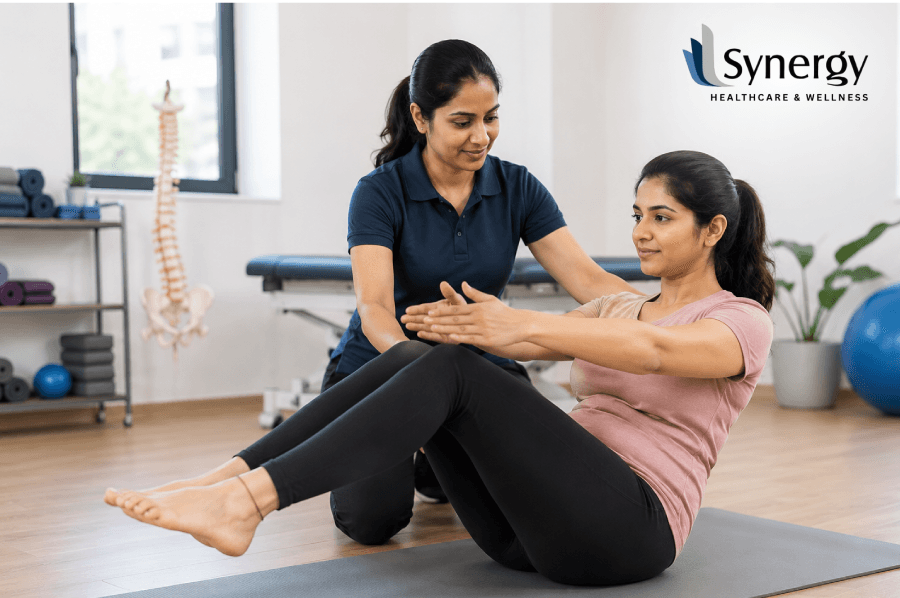
At Synergy, our dedicated women’s health physiotherapists offer customised, evidence-based treatment plans to help restore abdominal strength and function according to the extent of your abdominal separation. In addition to the attempt at closing the gap horizontally, the new goal in modern medicine is to bring functional tension back to the linea alba, thus making sure that your core can effectively transfer its weight without sagging or doming.
The path to recovery in Synergy follows a gradual process:
1. Re-training Diaphragmatic Breathing
The first stage entails retraining the breathing pattern in order to control intra-abdominal pressure. Deep, lateral costal breathing helps activate the deep core without forcing stressful outward pressure against a healing linea alba.
2. Isolated Transversus Abdominis Activation
Using targeted abdominal drawing-in manoeuvres, clients learn to gently contract the deepest layer of the abdominal wall. This exercise acts as a splint by bringing the two sides of the rectus close to each other and tensioning the fascia of the midline.
3. Co-contraction of the Pelvic Floor
Pelvic floor co-contraction alongside core contraction ensures even distribution of pressure and prevents excessive downward pressure in the pelvic region.
4. Progressive Functional Loading
After controlling the position statically, we then teach you how to perform dynamic actions such as squats, lunges, and lifts while maintaining a flat, stable, and strong abdominal wall.
With personalised training provided by our physiotherapists at Synergy, people who have structural separation can regain full core function, avoid future spine problems and successfully bridge the gap.
As your recovery progresses, structured rehabilitation focusing on flexibility and mobility can further improve movement quality. Read our article on How a Flexibility and Mobility Program Improves Body Movement.
Conclusion: Restore Strength, Stability, and Everyday Confidence
Navigating the physical changes of a post-pregnancy belly can feel overwhelming, but understanding what is diastasis recti empowers you to take control of your healing journey. Understanding the exact definition of diastasis recti changes everything about how you approach your postpartum recovery process, as it shifts the emphasis from surface-level beauty to fundamental functional stability.
Be it that you are facing the challenges of minor or severe diastasis recti, just remember that there is no doubt about your ability to recover when the right clinical approach is used. In order to not engage in any intensive generic training programmes but rather undergo a specialised rehabilitation process, you will be able to get rid of core instability once and for all while protecting yourself from any potential health issues in the future.
| Take the first step towards a stronger, more stable core with Synergy. Book a personalised physiotherapy assessment today and let our experienced team guide you through a safe, evidence-based recovery plan tailored to your postpartum needs. |
FAQs
1. What is the diagnosis for diastasis recti?
Diastasis recti is a medical condition that can only be correctly diagnosed through palpation or ultrasound examination, where there is a widening of the linea alba tissue, which is what separates the two halves of the rectus abdominis muscles. Health care practitioners also look at the degree of abdominal tension to diagnose the seriousness of the disease.
2. Can serious cases of diastasis recti be corrected without surgical procedures?
Yes, many severe cases of diastasis recti respond remarkably well to structured, long-term conservative physiotherapy targeting deep fascial tensioning and management of intra-abdominal pressure. Better recovery outcomes come from adding exercise routines with correct breathing mechanics and stepwise lifestyle changes.
3. Why does my postpartum belly look extended months after birth?
That’s why a stubborn post-pregnancy belly lingers. The unhealed separation in the midline allows internal organs to push forward against a weakened, soft abdominal wall. Other contributors to prolonged abdominal fullness may include hormonal changes, reduced muscle activation, and individual healing rates.
4. What do the diagnostic pictures of severe diastasis recti usually reveal in motion?
Medical illustrations and pictures of severe diastasis show a very distinct, prominent coning or tent-like protrusion along the central midline whenever the patient attempts to generate any core force. This image helps the clinicians describe the pattern of movements during rehab.
5. Are traditional crunches and standard sit-ups safe to do after pregnancy?
Initial traditional crunches are highly discouraged as they generate high intra-abdominal pressure that can push the healing muscle walls further apart. The safest way to get back to abdominal strength is to do gentle core activation exercises under the guidance of a physiotherapist.
6. How do I test myself at home for abdominal separation safely?
Lie on your back with your knees bent and gently lift your head, feeling a soft, clear space between the muscle borders by pressing your fingers vertically above your navel. It is useful to check yourself at home, but only a professional will be able to give you an accurate assessment.
7. Does an abdominal separation lead to low back pain and/or pelvic instability?
Yes, an abdominal separation poses a threat to spinal support and typically causes low back pain and pelvic girdle pain. It can help bring deep core stabilisation for mechanical load reduction and balance with normal activities.
8. What is the function of abdominal binders for early post-partum recovery?
While the function of abdominal binders as an external sensory stimulator and comforter for early mobility is legitimate, their usage is supposed to be combined with specific physical therapy exercises in order to strengthen the muscles. The function is temporary as well.
9. How long does core rehabilitation last in physical therapy?
The first signs of coordination appear within a few weeks, while the substantial progress requires twelve to sixteen weeks of regular training. Regular follow-up and home practice of the exercises that are prescribed will improve long-term recovery.
10. Is it ever too late to get professional treatment for an old abdominal separation?
It’s never too late to start rehab; the human neuromuscular system is capable of adapting and strengthening fascial tissue even years after your last pregnancy. Even if treatment is started later in life, a personalised programme can still improve posture, functional strength and quality of life.

Dr. Suresh Franklin, MPT
✓ 15+ Years of ExperienceMeet Dr. Suresh Franklin, MPT – the expert behind Synergy Physio Care's clinical approach. With extensive experience in sports rehabilitation, athlete recovery, and performance care, he brings trusted expertise to every piece of content we publish. From injury management to movement-based recovery, his review helps ensure our blogs are practical, accurate, and patient-focused. At Synergy, we combine clinical knowledge with real-world physiotherapy experience to guide every recovery journey.