A short daily routine of daily physiotherapy stretches can ease stress, release tension in common problem areas and improve posture. By moving the neck, spine, hips and legs through controlled ranges, you support joint strength and calm the nervous system. The blog explains a practical 10-minute sequence, safer variations and when to seek individual assessment from a physiotherapist in Chennai.
Let’s Begin
Modern life asks a great deal of the body. Long hours at a desk, time spent in traffic and constant digital noise all place the nervous system under strain. The result is often familiar: a tight neck, stiff shoulders, a dull ache in the lower back and a sense that the body never quite relaxes.
A short daily stretching routine, designed with physiotherapy principles in mind, can help to break that pattern. Gentle, regular stretches calm the nervous system, ease muscle tension and keep key muscle groups strong enough to support you through the day.
This blog sets out a practical daily routine you can follow at home. It is suitable for most adults who wish to reduce stress, feel more comfortable in their bodies and maintain a basic level of strength.
How Stress Affects Your Body
When you feel under pressure, your body prepares for action through the stress response. Muscles tighten, breathing becomes shallow, and the heart beats faster. This response is useful in the short term. When it continues for many hours every day, it creates problems.
Common physical effects of ongoing stress include:
- Persistent tightness in the neck, jaw and shoulders
- A sense of heaviness or stiffness in the mid and lower back
- Tension headaches
- Shallow breathing that leaves you feeling short of breath
- Difficulty relaxing or falling asleep
Over time, the body may begin to compensate. Some muscles work too hard while others switch off. Joints can then become overloaded, which increases the risk of pain, strain and injury.
A structured programme of daily physiotherapy stretches helps to interrupt this cycle. The aim is not extreme flexibility. The goal is calm, comfortable movement and steady support for the joints that work hardest for you.
Why A Daily Physiotherapy Stretching Routine Works
A well-chosen set of stretches offers several benefits at once.
1. Calms the nervous system
Slow, controlled movement combined with steady breathing sends a clear signal of safety to the brain. This reduces muscle guarding, which is the subconscious tightening that often accompanies stress and pain.
2. Releases common tension areas
Most people under stress tighten the same regions: neck, shoulders, chest, lower back and hips. Stretching these specific areas improves circulation, increases tissue temperature and allows muscles to lengthen to a comfortable resting length.
3. Supports strength and joint control
Holding a stretch with good alignment lightly activates stabilising muscles. Over time, this improves endurance and helps key muscle groups support the spine, hips and shoulders. The routine below includes small elements of strength work within each position.
4. Improves posture and body awareness
When joints move regularly through a healthy range, it becomes easier to sit, stand and walk with less effort. You begin to notice early signs of tightness and can respond before they build into pain.
5. Lifts mood and energy
Gentle physical activity is known to support the release of feel-good chemicals in the brain. Many people report feeling clearer, calmer and more alert after a short stretching session.
How To Use This Routine Safely
Most healthy adults can perform these stretches. However, you should speak to a physiotherapist or doctor before starting if you:
- Have had recent surgery or injury
- Experience severe or unexplained pain
- Have marked weakness, numbness or tingling in the arms or legs
- Feel dizzy, unsteady or breathless with light activity
- Have been told you have serious heart or lung disease
General safety guidelines:
- Move into each stretch slowly until you feel a mild to moderate stretch, not sharp pain
- Hold the position and breathe steadily
- Do not bounce or force a joint beyond its comfortable range
- If a movement causes sharp, severe or worsening pain, ease out of it and leave it out of your routine
- Aim to practise most days of the week, even if you only have a few minutes
If you are unsure whether a particular stretch is appropriate for your condition, a physiotherapist can assess you and adapt the routine.
Your 10-Minute Daily Physiotherapy Stretch Routine
If you have ten minutes, the following sequence provides a simple full-body routine. You can perform it once a day, or twice on busier days, for example, morning and evening.
A quick overview:
- Diaphragmatic breathing with shoulder drop
- Neck side stretch and rotation
- Upper shoulder and side of neck stretch
- Chest doorway stretch
- Seated thoracic rotation
- Cat and camel
- Child’s pose
- Half-kneeling hip flexor stretch
- Hamstring stretch
- Calf stretch against the wall
You do not need special equipment, only a mat or firm surface and a clear wall or doorway.
1. Diaphragmatic breathing with shoulder drop
Targets: Breathing pattern, upper shoulder tension
Helps with: Settling the nervous system before you stretch
- Sit or stand tall with the shoulders relaxed. Place one hand on your chest and one on your abdomen.
- Breathe in gently through the nose, allowing the abdomen to rise under your lower hand. The upper hand on the chest should move as little as possible.
- As you breathe out slowly through the mouth, let the shoulders soften and drop away from the ears.
- Continue for 5 to 8 breaths.
Keep the jaw relaxed and the neck long. This sets the tone for the rest of the routine.
2. Neck side stretch and rotation
Targets: Side of the neck and upper shoulder muscles
Helps with: Desk-related neck tension and stress headaches
- Sit upright on a chair with both feet flat on the floor.
- Gently tilt your right ear towards your right shoulder until you feel a stretch along the left side of your neck.
- Hold for 20 to 30 seconds while breathing steadily.
- Return to the centre and repeat on the other side.
- Then, gently turn your head to look over your right shoulder and hold for 15 seconds, followed by the left.
Avoid lifting the shoulder towards the ear. Keep both shoulders relaxed.
3. Upper shoulder and side of neck stretch
Targets: Upper trapezius and levator scapulae muscles
Helps with: Shoulder tightness from stress and poor posture
- Sit tall. Hold the edge of the chair with your right hand to keep your shoulder gently lowered.
- With your left hand, lightly hold the back of your head.
- Turn your nose slightly towards the left armpit, then gently guide the head forward and down until you feel a stretch along the back and side of the right neck.
- Hold for 20 to 30 seconds.
- Swap sides.
The pressure from the upper hand should be very light. You are guiding, not forcing, the movement.
4. Chest doorway stretch
Targets: Chest muscles and front of the shoulders
Helps with: Rounded posture, upper back strain and shallow breathing
- Stand in an open doorway. Place your forearms on either side of the frame, with elbows roughly at shoulder height.
- Step one foot forward and gently lean your body weight through the doorway until you feel a stretch across the front of the chest and shoulders.
- Keep the neck long and avoid arching the lower back.
- Hold for 20 to 30 seconds while breathing slowly.
- Step back out of the stretch.
If you feel any tingling or numbness in the arms, reduce the depth of the stretch or lower the arm position.
5. Seated thoracic rotation
Targets: Middle and upper back
Helps with: Stiffness from prolonged sitting and improves rotation
- Sit towards the front of a chair with feet flat and knees hip-width apart.
- Cross your arms over your chest or rest your hands on your shoulders.
- Gently turn your torso to the right, as if looking over your shoulder, while keeping hips and knees facing forward.
- Pause when you feel a gentle stretch along the spine and ribs. Hold for 10 to 15 seconds.
- Return to the centre and repeat to the left.
- Perform 3 to 4 turns in each direction.
Move smoothly without jerking. Focus on the ribs and chest turning, not just the neck.
6. Cat and camel
Targets: Spine mobility and deep spinal muscles
Helps with: Lower and mid-back stiffness
- Position yourself on all fours on a mat. Hands are under the shoulders, and knees are under the hips.
- As you breathe out, gently round your back towards the ceiling, tucking your tailbone slightly and allowing the head to relax between the arms.
- As you breathe in, move slowly into the opposite position by lifting the tailbone and chest so the spine gently arches, keeping the neck long.
- Move between these two positions for 8 to 10 repetitions.
Keep the movement comfortable and avoid forcing the range. The focus is on smooth, controlled motion.
7. Child’s pose
Targets: Lower back, hips and shoulders
Helps with: General relaxation and spinal decompression
- From all fours, sit your hips back towards your heels while reaching your hands forward on the floor.
- Allow your chest to sink towards the thighs and rest your forehead on the mat or on a folded towel.
- Breathe steadily, feeling the back of the ribs widen with each inhale.
- Hold for 30 to 45 seconds.
If it is difficult to sit back fully, place a folded blanket between your calves and thighs for support.
8. Half-kneeling hip flexor stretch
Targets: Front of the hip and thigh
Helps with: Hip tightness from sitting and supports upright posture
- Kneel on a mat. Step your right foot forward so you are in a half-kneeling position with the right knee bent at about ninety degrees.
- Gently tuck your pelvis under, as if bringing your tailbone slightly forward.
- Keeping the trunk upright, shift your weight slightly forward until you feel a stretch at the front of the left hip and thigh.
- Hold for 20 to 30 seconds.
- Swap legs.
Avoid arching the lower back. The sensation should be at the front of the hip, not in the back.
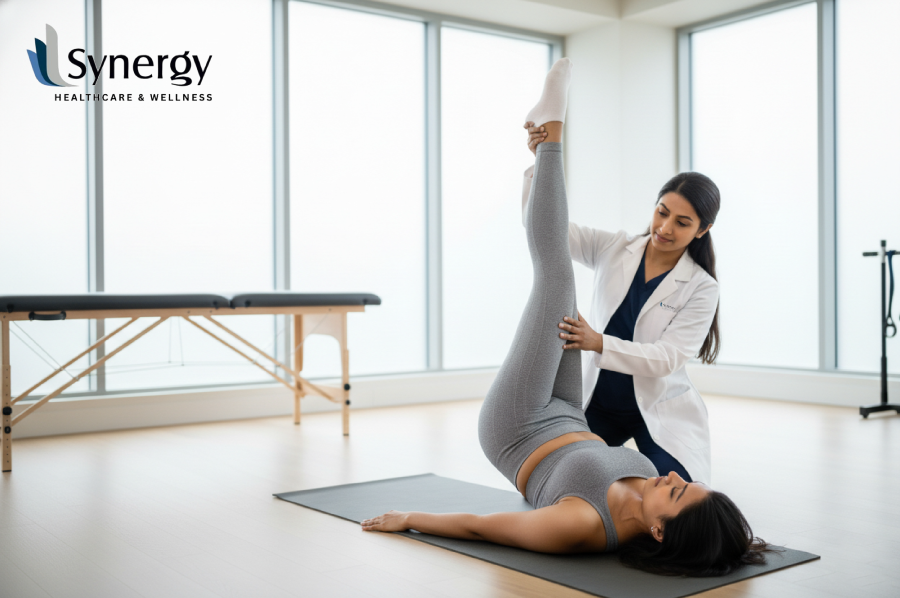
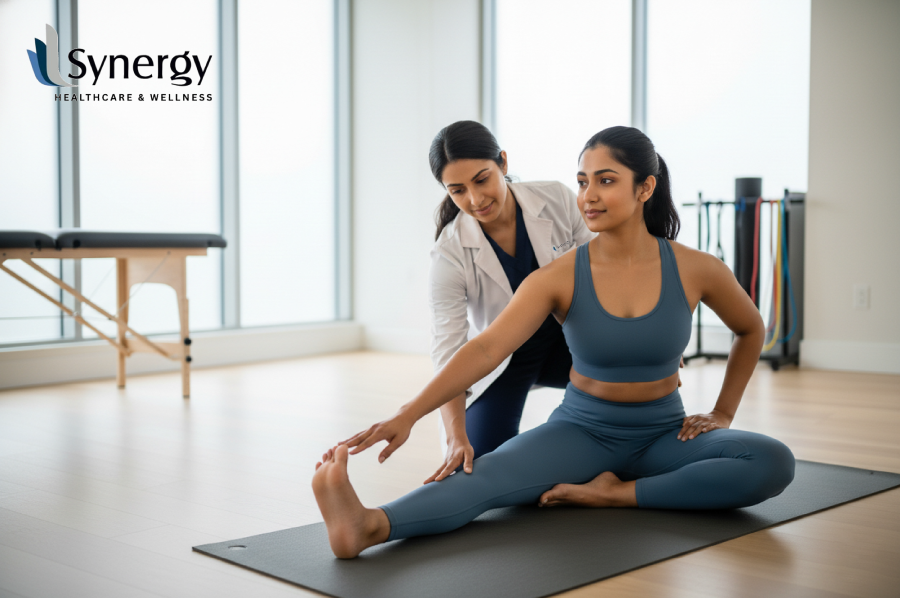
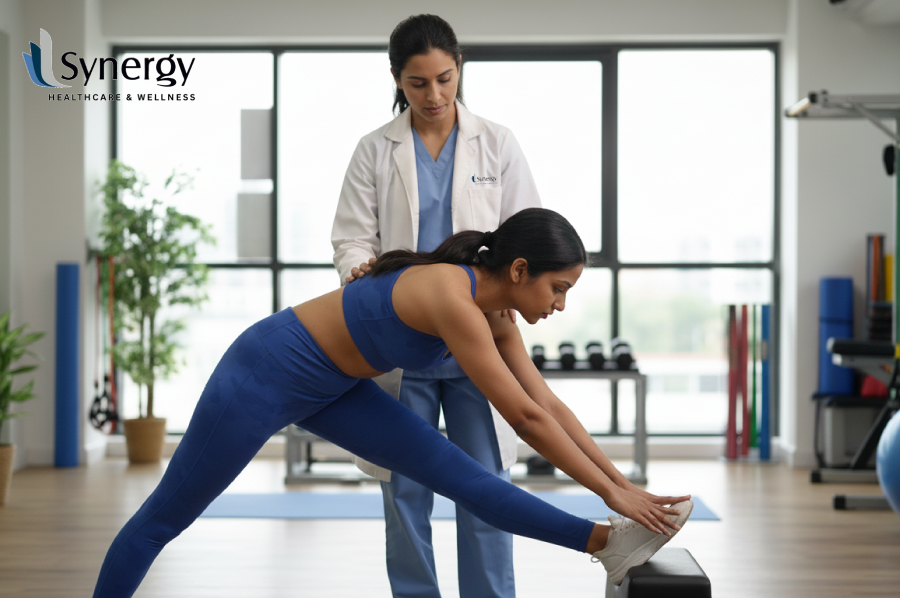
9. Hamstring stretch
Targets: Back of the thigh
Helps with: Lower back strain and leg stiffness
Option seated:
- Sit on the edge of a chair. Straighten your right leg with the heel on the floor and toes pointing up.
- Keeping your back long, hinge forward from the hips until you feel a stretch along the back of the right thigh.
- Hold for 20 to 30 seconds, then repeat on the left.
Option lying:
- Lie on your back with both knees bent.
- Loop a towel or strap around the back of the right thigh or heel.
- Gently straighten the knee towards the ceiling until you feel a comfortable stretch.
- Hold for 20 to 30 seconds, then repeat on the other side.
Only move to a level of stretch that allows easy breathing and relaxed shoulders.
10. Calf stretch against the wall
Targets: Calf muscles
Helps with: Walking comfort and ankle mobility
- Stand facing a wall and place both hands on it at shoulder height.
- Step the right foot back, keeping the heel down and the knee straight.
- Gently lean the body forward until you feel a stretch along the back of the right calf.
- Hold for 20 to 30 seconds, then repeat on the other side.
Keep the back foot pointing straight ahead rather than turning outwards.
Short Variations For Morning, Workday And Evening
On some days, you may not complete the full routine. It is still worthwhile to do a shorter version that suits the time of day.
Morning energiser (about 5 minutes)
- Diaphragmatic breathing with shoulder drop
- Chest doorway stretch
- Cat and camel
- Half-kneeling hip flexor stretch
This combination opens the chest and hips and wakes up the spine so you start the day upright and alert.
Desk break for work stress (about 5 minutes)
Perform these near your desk or work area:
- Neck side stretch and rotation
- Upper shoulder and side of neck stretch
- Seated thoracic rotation
- Seated hamstring stretch
These movements directly address the areas that tighten during long sitting and computer work.
Evening unwind (about 5 to 7 minutes)
- Diaphragmatic breathing with shoulder drop
- Cat and camel
- Child’s pose
- Calf stretch
This set is gentle, rhythmical and ideal before bed to help the body relax after a busy day.
Simple Habits That Make Your Stretches More Effective
The routine above is most effective when it sits within a few broader habits.
- Move regularly throughout the day
Stand up, walk for a minute or change position at least once every half hour where possible. - Use your breath
Try to pair stretching with slow nasal breathing. Count to four on the inhale and five or six on the exhale. A longer, slower out-breath often feels especially calming. - Supportive workspace
Arrange your chair, screen and keyboard so that your head is balanced over your shoulders and your elbows rest at roughly right angles. Small changes in set-up can greatly reduce strain. - Sleep and hydration
Muscles recover and adapt when you sleep. Adequate rest and regular water intake support tissue health.
These simple measures, combined with your daily stretches, create a solid base for both physical comfort and emotional resilience.
Synergy Healthcare & Wellness: Get The Best Physiotherapy Support In Chennai
Self-care is a valuable first step, yet some situations require professional assessment. You should seek advice from a physiotherapist if:
- Pain persists for more than a few weeks despite regular stretching
- You experience tingling, numbness or weakness in the arms or legs
- Pain wakes you at night or is accompanied by unexplained weight loss or fever
- You have a history of significant trauma, such as a fall or accident
- Movements feel unstable, or joints give way unexpectedly
At Synergy Healthcare & Wellness, our physiotherapists in Anna Nagar, T. Nagar, and Adyar regularly see people whose pain is closely linked to stress, posture and work demands. A full consultation includes a careful history, physical examination and, where needed, tailored advice on posture, manual therapy and a personalised exercise programme.
If you recognise your own symptoms in this article, a session with a physiotherapist can help to identify the exact structures involved and adapt these stretches to suit your body.
Summing Up
Regular, thoughtfully designed stretching is a simple yet powerful way to care for both body and mind. A few quiet minutes each day can ease the strain of modern life, support strength around key joints and give you a greater sense of control over your own well-being.
If you would like individual guidance or if your pain has been slow to settle, the physiotherapy team at Synergy Healthcare & Wellness in Chennai can assess your condition and tailor a programme to suit your goals. A small change in your daily routine can, over time, make a marked difference to how you move, work and rest.
FAQ’s
How often should I do these daily physiotherapy stretches?
For most people, once a day is a good starting point. On days when you feel particularly tense or have spent many hours sitting, you may repeat a shorter version of the routine. Consistency is more valuable than intensity. Ten minutes every day is usually better than a long session once a week.
How long should I hold each stretch?
A hold of 20 to 30 seconds is appropriate for most of the positions described here. Shorter, repeated holds can also work well, especially if you are new to stretching. For example, you might hold for 15 seconds, relax, then repeat two or three times.
Can stretching alone make me stronger?
These stretches gently activate stabilising muscles, which support joint control and endurance. For more significant gains in strength, you would add specific strengthening exercises using body weight, resistance bands or weights. Many people find that stretching first allows them to perform strengthening work with better form and comfort.
Is it normal to feel a mild ache after stretching?
A light sense of effort or mild muscle ache is common when you introduce any new activity. This should settle within a day or two. If pain is sharp, severe, or continues to worsen, stop the movement that causes it and seek professional advice.
Is it better to stretch in the morning or evening?
Both can be helpful. Morning stretching tends to prepare the body for the day and reduce stiffness upon waking. Evening stretching can help to release the build-up of tension from work and commuting and may assist with relaxation before sleep. Many people choose a shorter routine in the morning and a slightly longer one at night.
Are these stretches suitable for older adults?
In many cases, yes, provided the movements are adapted to suit the individual’s mobility, balance and medical history. Older adults may prefer chair-based versions of some positions. It is wise to discuss the routine with a physiotherapist before starting, especially if you have osteoporosis, heart disease or balance difficulties.