Short Summary:
If you want to turn back the clock on the consequences of sedentary lifestyle and the loss of flexibility with ageing, you have to start a program for flexibility restoration. Evidence-based and mobilisation, based stretching methods can help you recover joint flexibility and muscle elasticity. Discover how Synergy combines professional physiotherapy techniques with the creation of personalised rehabilitation programs that are fit for maintaining your fitness and optimal physical condition in the long run.
The Clinical Necessity of Flexibility Restoration
Stiffness is often the first warning sign that your body’s musculoskeletal system is under stress. Whether it is the morning “creakiness” in your lower back or the inability to reach overhead without discomfort, restricted mobility is more than an inconvenience; it is a mechanical failure. In 2026, the focus of modern sports medicine has shifted from mere pain relief to comprehensive flexibility restoration.
Muscles and joints can only support the body to a certain extent within a certain “envelope of function”. The body, when tissues become tighter or joint capsules get stiffer due to lack of use, injury, or inflammation, tries to compensate by different parts, which in this way causes more pain. In order to get back to normal functioning, you can’t just keep stretching on a whim anymore. You must choose a method, scientifically proven, and stick to it. You must reprogram your nervous system, strengthen the viscoelastic properties of muscle-tendon units, and be sure that your joints can move freely through their full range of motion if you want to be flexible again. At Synergy, we don’t just want to relieve pain right away; we also want to make the structural changes that will help you move better in the long term.
Why Muscles and Joints Become Stiff: The Science of Restriction?
Understanding the “why” behind your stiffness is the first step toward effective flexibility restoration. There are a few physiological reasons why the range of motion is lost:
- Tissue Cross-Linking: Collagen fibres that are not active in your fascia and tendons can form “cross-links” that act like “internal glue” to stop your joints from moving smoothly.
- Neural Tension: Your nervous system can also be tense, not just your muscles. If your brain thinks your joints are unstable, it will “lock down” the muscles around them to keep them safe.
- Sarcopenia due to age: As we get older, our muscles will slowly lose water and elasticity. The Journal of Ageing and Physical Activity published a study that shows that regular flexibility training can slow this process down.
- Inflammatory adhesions: After an injury, your body makes scar tissue. If a professional doesn’t move this tissue, it will get stiff and limit your natural range of motion.
Evidence-Based Techniques for Restoring Mobility
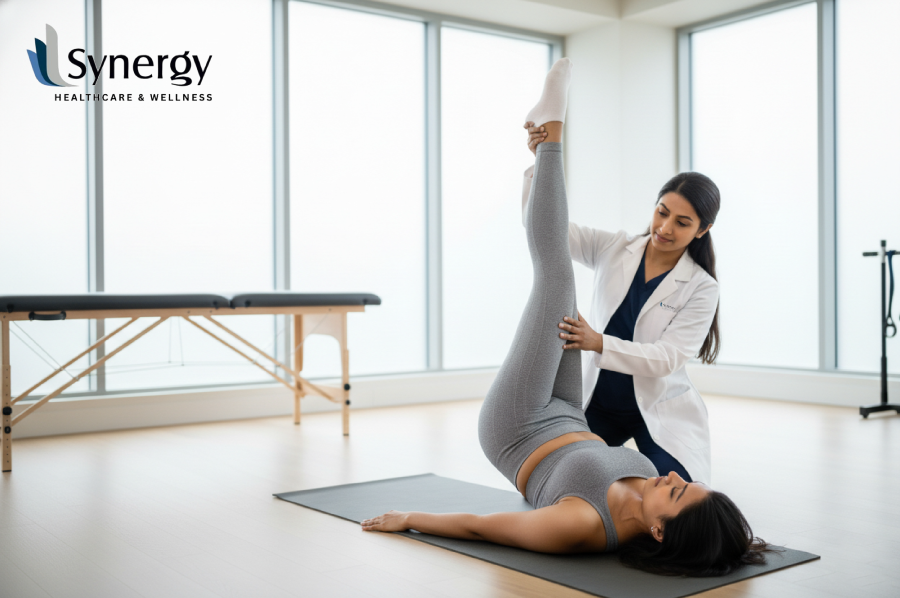
A complete flexibility restoration plan should involve a combination of different stretching modalities, each serving a unique purpose in the recovery timeline.
1. Static Stretching (Maintenance)
This involves holding a muscle in a lengthened position for 30–60 seconds. It is the most common form of stretching and is highly effective for increasing “stretch tolerance”—the brain’s ability to allow a muscle to lengthen without triggering a protective contraction.
2. Dynamic Mobilisation (Preparation)
Instead of holding still, dynamic stretching involves controlled, rhythmic movements that take the joint through its full range. This is the gold standard for warm-ups, as it increases blood flow and “wakes up” the nervous system. Check out our guide on rehab exercise programs for more on how to integrate these into a recovery plan.
3. PNF Stretching (The Clinical Edge)
Proprioceptive Neuromuscular Facilitation (PNF) involves a “contract-relax” sequence. By briefly contracting the muscle you are trying to stretch, you trigger a deep reflex called “autogenic inhibition,” which allows the muscle to relax and lengthen further than a standard stretch would allow.
4. Myofascial Release
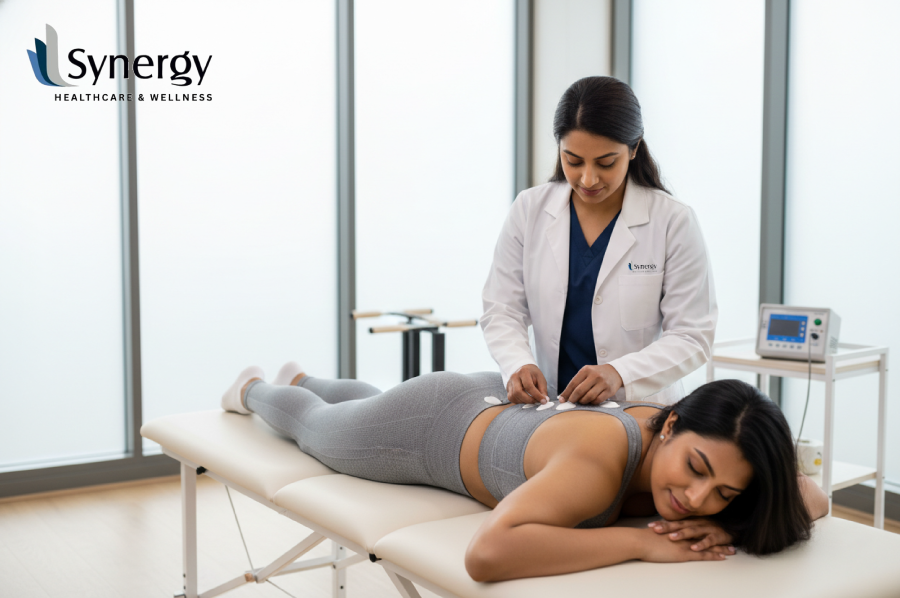
Using tools like foam rollers or professional manual therapy, this technique targets the fascia (the cling-film-like wrap around your muscles). Breaking down fascial restrictions is often the “missing link” in achieving lasting flexibility.
Targeted Flexibility Exercises for Daily Life
Kick off your path by narrowing down the key areas that typically get stiff:
- The World’s Greatest Stretch: This is a blend of a lunge, hamstring stretch, and thoracic rotation. The hips, spine, and shoulders are all taken care of in just one motion.
- The 90/90 Hip Switch: After sitting on the floor with your knees bent at 90-degree angles, you have the hip capsules opened.
- Wall Chest Stretch: Essential for those who spend hours at a computer, helping to reverse “rounded shoulder” posture. For more on posture, see our article on core strengthening routines.
Comparison of Flexibility Modalities
| Technique | Primary Mechanism | Best Used For | Clinical Level |
| Static Stretching | Viscoelastic change | General maintenance | Beginner |
| Dynamic Stretching | Neural activation | Pre-workout / Warm-up | Intermediate |
| PNF Stretching | Neuromuscular inhibition | Rapid ROM gains | Advanced / Clinical |
| Manual Mobilisation | Joint capsule release | Post-injury / Surgery | Expert (Therapist-led) |
Synergy: A Passage to Pain-Free Movement and Vitality
Synergy represents a sophisticated evolution in the field of physical rehabilitation, where the traditional boundaries of physiotherapy are expanded through a holistic, patient-centric philosophy. At the heart of the Synergy experience is a commitment to “Precision Recovery”—a belief that every movement should be dictated by clinical data and an intimate understanding of individual biomechanics. The team, which is made up of senior specialists, doesn’t see each patient as a list of symptoms. Instead, they see them as a living system that can change deeply.
Synergy is a great place for people who want to go beyond the limits of a stiff or injured body because it combines the best of Manual Therapy with the newest research in exercise science. Their philosophy is based on education, and they will give you the tools you need to keep your progress long after you leave their clinic. Synergy has the knowledge and the space to help you get your body back to its best working level, whether you are an athlete looking for a competitive edge or a professional who wants to get rid of the effects of a sedentary lifestyle.
The Path to Lasting Physical Freedom
A marathon, not a sprint, is the key to getting your flexibility restoration. It means changing how you see stretching, going from seeing it as a chore to seeing it as a necessary “tune-up” for your body’s complicated machine. You can get rid of years of stiffness and protect yourself from future injuries by combining self-care exercises with professional knowledge.
We at Synergy are dedicated to helping you move freely and without any problems. Our personalised programs are made to help you exactly where you are, whether you have stiffness from getting older or a complicated sports injury. Keep in mind that a body that is flexible is strong. Don’t let stiffness control your life; start your journey to a more flexible, glowing you today.
Get back your full range of motion. Find out about the Synergy solution and set up your professional mobility evaluation.
FAQs
1. Is it better to stretch before or after exercise for flexibility restoration?
Current research, such as that found in the British Journal of Sports Medicine, suggests dynamic movements before exercise and static/PNF stretching afterwards for the best results.
2. How often should I perform flexibility exercises to see results?
For significant flexibility restoration, a frequency of 3 to 5 times per week is recommended to allow the nervous system and tissues to adapt.
3. Can stretching alone fix joint stiffness?
While stretching helps, joint stiffness often requires “mobilisation”—a therapist-led technique used at Synergy to address the actual joint capsule rather than just the muscles.
4. Why do my muscles feel even tighter after I stretch?
If you are stretching too hard, this is a common problem. When you activate the “stretch reflex,” the muscle will tighten up to keep itself from getting hurt.
5. Can “Text Neck” be eased through stretches?
Absolutely, performing the chin tuck exercise and doorway chest stretching are two great stretches that can help you eliminate the forward head posture commonly seen in mobile device users.
6. Are there such things as “Synergy” flexibility programs that are solely tailored to the individual?
At Synergy, the patients receive a personal program which is completely tailored to the range of motion limitations and the lifestyle requirements of each individual.
7. What is the duration needed for a permanent improvement in flexibility?
Long-term improvement in flexibility usually comes from consistent training for at least 6 to 12 weeks. It is true that you can experience some quick gains in your range of motion due to your nervous system adapting, but if you want structural changes in muscles and connective tissues which last, you will need time and repetition.
8. Is it possible to regular stretch workouts reduce the risk of injury?
Yes. When muscles and joints can move smoothly through their natural range without any limitation, the tissues around them do not have to get overstretched to compensate. This balanced mobility minimises the chances of muscle pulling, tendon irritation, and joint overload.
9. Is morning stiffness a symptom that I need to restore my flexibility?
If you wake up stiff quite often, it may be a sign that the tissues in your body have become less elastic and the joints are somewhat restricted. Light locomotor activities right after you get up can help to improve the blood flow so that you will get rid of the stiffened feeling step by step.
10. Is it ever appropriate for flexibility exercises to cause pain?
No. A slight sensation of tension or discomfort in the muscles due to stretching is completely normal, but if you experience sharp or severe pain, then this is a sign that you may be damaging the tissues by overstressing them. Stretching should be a normal, smooth extension of your muscles and an upward progression and not a stressful activity which is forced on you.