

Short Summary:
Forget reactive healthcare. Injury prevention physiotherapy is the sophisticated science of “Prehabilitation,” designed to bulletproof your joints against the inevitable stresses of life and sport. At Synergy, we use advanced biomechanical analysis to identify structural “energy leaks,” ensuring your body remains a high-performance machine that resists wear, tear, and the biological clock while promoting strength, stability, resilience, and long-term movement efficiency.
Introduction: The Myth of the “Sudden” Injury
We’ve all heard the story: someone reaches for a pencil or steps off a kerb, and their back “goes.” We call these accidents. In reality, these are rarely sudden. They are the climax of a long, silent process called Micro-Trauma Accumulation.
Think of your joints like a high-end sports car. If the alignment is out by just one millimetre, you won’t notice it driving to the shops. But drive at 100mph for three years, and that tyre will eventually explode. Your body is exactly the same. Injury prevention physiotherapy is the elite mechanic who finds that one-millimetre deviation before the “tyre” blows out on the motorway.
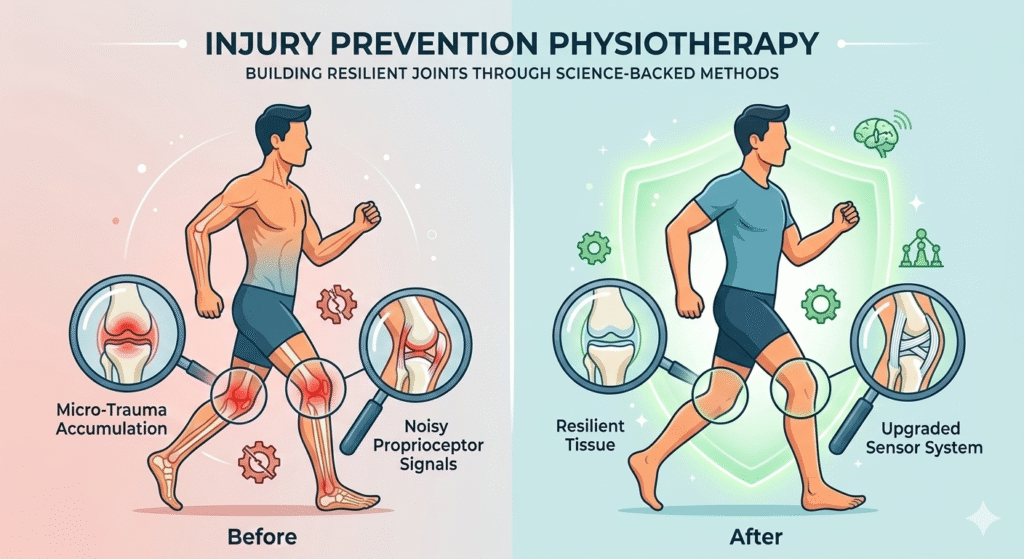
(This infographic split into “Before” and “After” scenarios illustrating injury prevention physiotherapy.)
The Science of Joint Shielding through Injury Prevention Physiotherapy
The Science of Joint “Shielding”
Your joints are not just hinges; they are complex sensory organs. Every time you move, thousands of “Proprioceptors” (position sensors) send data to your brain.
When you have a movement “glitch”—perhaps from sitting too long or a previous ankle sprain—this data becomes “noisy.” Your brain stops trusting the joint and starts “guarding” it by tightening the surrounding muscles. This creates friction, which leads to cartilage thinning.
According to clinical research in the British Journal of Sports Medicine, proactive neuromuscular training can recalibrate this sensor system, reducing the risk of non-contact ligament tears by over 50%. At Synergy, we aren’t just stretching muscles; we are “upgrading the software” of your nervous system.
Beyond the Basics: How We Build Resilient Tissue
At Synergy, we don’t follow a generic checklist. We look at the Kinetic Chain. If your shoulder hurts, we look at your opposite hip. Why? Because the body moves in “slings.” A weak left glute forces the right shoulder to overwork during a tennis serve or even while carrying groceries.
1. The Force Absorption Capacity
Most people train to produce force (lifting weights). We train you to absorb force. Every step you take sends a shockwave through your ankles, knees, and spine. Injury prevention physiotherapy teaches your muscles to act as “hydraulic dampers,” soaking up that energy so your cartilage doesn’t have to.
2. Tissue Tolerance Loading
We use a medical principle called Mechanotransduction. By applying specific, controlled loads to your tendons and ligaments, we actually signal the cells to become denser and tougher. We are literally changing the physical “toughness” of your internal structures.
3. Deceleration Mastery
Most injuries happen when you try to stop or change direction. We focus on “Eccentric Control”—the ability of your muscles to lengthen under tension. This is the ultimate “brakes” system for your joints.
High-Performance Habits for the Modern Human
If you want to move like a 20-year-old when you’re 60, you need to implement these “Biological Upgrades”:
- The Foot-Brain Connection: Spend time balancing on one leg on an unstable surface (like a folded towel). This forces the small stabiliser muscles in your hip and ankle to communicate, creating a “reflexive shield” against sprains.
- The Thoracic Opening: Modern life pulls us into a “C-shape.” Five minutes of foam rolling your upper back daily can prevent 80% of rotatory cuff issues in the shoulder by giving the joint the space it needs to move.
- Eccentric Strengthening: When you do a squat or a step-up, take 4 seconds to go down and 1 second to go up. This builds the tendon strength that is the hallmark of injury prevention physiotherapy.
Is Your Body “Leaking” Energy?
You might not be in pain, but you might be “leaking” potential. At Synergy, we look for these red flags during a screening:
- The Valgus Collapse: Do your knees cave inward when you jump or sit? This is a primary predictor of ACL issues.
- The Trendelenburg Sign: Does your hip drop when you walk? This indicates gluteal amnesia, which leads to lower back degeneration.
- Reduced Dorsiflexion: If your ankles are stiff, your knees and back must compensate.
By addressing these before they hurt, you aren’t just preventing injury; you are unlocking a level of athletic performance you didn’t know you had.
Our Clinical Vision at Synergy Healthcare
At Synergy, we believe that the best injury is the one that never happens. We are a specialised rehabilitation and wellness centre built on clinical expertise and patient trust. Our work is defined by structured, evidence-based practice, focusing on the proactive health of our community in Chennai.
We don’t just wait for you to come to us with an injury. At our clinics in Anna Nagar, Adyar, and T. Nagar, we offer comprehensive “Pre-habilitation” screenings. We use a multidisciplinary approach that combines medical knowledge with cutting-edge therapy to keep you active and productive, whether you’re on the pitch, at work or on your feet.
| Strategy | Biological Result | Daily Application |
| Plyometric Priming | Increased Tendon Elasticity | 2 mins of “Pogo Hops” or light jumping. |
| Isometrics | Neural Pain Inhibition | 30-second wall sits to “quiet” the patellar tendon. |
| Rotational Flow | Spinal Decompression | Multi-planar lunges to keep the vertebral discs hydrated. |
When to Upgrade from “Self-Care” to “Expert-Care”
You shouldn’t wait for a “pop” or a “snap.” Professional injury prevention physiotherapy at Synergy is necessary if:
- You are starting a new fitness regime (Couch to 5K, CrossFit, etc.).
- You have a history of “recurring” minor issues.
- You feel “stiff” for more than 15 minutes after waking up.
- You want to maximise your career longevity in high-impact sports or demanding physical jobs.
Conclusion
Your body is the only “home” you have to live in for your entire life. While most people wait for the roof to leak before calling a builder, the smartest movers invest in the foundation. Injury prevention physiotherapy is that investment. It is the difference between a life of limitation and a life of limitless movement. At Synergy, we provide the blueprints, the tools, and the expertise to help you build a body that lasts. Let’s stop talking about “getting older” and start talking about “getting stronger.”
FAQs
1. Is injury prevention physiotherapy only for professional athletes?
No, because every person uses their joints daily; Injury prevention physiotherapy is equally vital for office workers and retirees to maintain a high quality of life.
2. Can I start an injury prevention physiotherapy program if I already have a “dodgy” knee?
Yes, you should definitely start, as injury prevention physiotherapy is specifically designed to stop that “dodgy” joint from causing a secondary injury elsewhere in your body.
3. Does this type of physiotherapy involve a lot of heavy lifting?
Not necessarily; you will find that injury prevention physiotherapy focuses more on “control” and “precision” using bodyweight, bands, and balance tools rather than just raw weight.
4. How does injury prevention physiotherapy differ from a standard gym warm-up?
While a warm-up gets your blood flowing, injury prevention physiotherapy targets your specific neurological weaknesses and structural imbalances that a generic warm-up would miss.
5. How quickly will I feel the “longevity” benefits?
You will likely feel more “stable” and “lighter” in your movements within 3 to 4 weeks of starting a consistent injury prevention physiotherapy routine.
6. Is injury prevention physiotherapy expensive compared to surgery?
No, you will find that a few sessions of injury prevention physiotherapy cost a fraction of a surgical procedure and save you months of lost income and rehabilitation time.
7. Can I do these prevention exercises at home?
Yes, at Synergy, we give you a tailored “digital toolkit” so you can perform your injury prevention physiotherapy drills anywhere, ensuring consistency and results.
8. Why is “proprioception” so important in preventing injury?
Because if your brain knows exactly where your joint is in space, it can fire your “protector” muscles faster, which is the core goal of injury prevention physiotherapy.
9. Can better movement quality actually improve my mood?
Yes, because reducing the “background noise” of chronic stiffness through injury prevention physiotherapy lowers cortisol levels and allows you to enjoy physical activity more.
10. How do I book a “Movement Audit” at Synergy?
You can simply visit the Synergy website to book an assessment and begin your journey toward total injury prevention physiotherapy mastery.