
Short Summary:
The best way to get your strength and freedom back after an injury or surgery is to learn rehab exercise programs. Patients can be sure of a safer and faster return to peak performance by moving from pain management to functional loading in phases based on evidence. Learn how Synergy uses both clinical knowledge and systematic methods to provide a non-invasive and evidence-based solution for long-term physical resilience and recovery.
The Strength of Structure in Healing the Body
When you have a bad injury or stiffness after surgery, the natural thing to do is to take it easy. However, modern sports medicine has proven that “passive rest” is frequently counterproductive. To truly heal, the body requires a blueprint. This is where rehab exercise programs become indispensable.
Unlike a generic gym workout, a structured rehabilitation program is a medical intervention. It is a calculated progression of movements designed to respect the biological stages of tissue healing. Whether you are dealing with a chronic back condition or a sudden ligament tear, the goal is to bridge the gap between initial injury and full functional independence. At Synergy, we don’t just “give exercises”; we prescribe a journey of adaptation that restores your body’s “envelope of function”, ensuring you return to your daily life stronger than before.
The Science of Phased Rehabilitation
A successful recovery is never a straight line, but it should follow a predictable clinical framework. Experts agree that structured programs must move through distinct phases to avoid reinjury.
Phase 1: Acute Stage – Safeguarding the Injury and Controlling Pain
In the first few days following an injury, the focus is on controlling inflammation and preventing muscle atrophy without overstressing healing tissues.
Goal: Reduce swelling and restore basic joint mobility.
- Isometric exercises and range of motion (ROM) exercises are common treatments.
Clinical Insight: A study in the Journal of Athletic Training shows that controlled movement is much better than complete immobilisation.
Step 2: The Sub-Acute Phase (Getting Stronger and More Flexible)
The next step is to lay the groundwork after the pain has gone down. This is where “progressive loading” begins.
Goal: Improve muscle endurance and work on patterns of compensation.
- Resistance band exercises, squats, and balance exercises are all common ways to help.
- During this phase, isotonic rehab exercise programs are meant to rearrange the collagen fibres in tendons and ligaments.
Phase 3: The Functional Phase (Power and Getting Back to Work)
This is the last step, when the “patient” turns back into an “athlete.”
Goal: Imitate useful tasks, like running or climbing stairs.
- Agility training, plyometric training, and sport-specific training are also very typical to be seen.
Synergy: Getting Better and Staying Healthy
One size fits all simply doesn’t work, and we know that a time is different, just like every injury is different. The concept of “clinical precision” is what lies behind our centres in Chennai.
- Senior Doctor Assessment: At Synergy Healthcare, our senior doctors carry out a thorough evaluation of each patient to determine the root cause of their symptoms, rather than just identifying the symptoms.
- Condition-Specific Protocols: We have designed special rehab exercise programs for senior health, back pain, and ACL recovery.
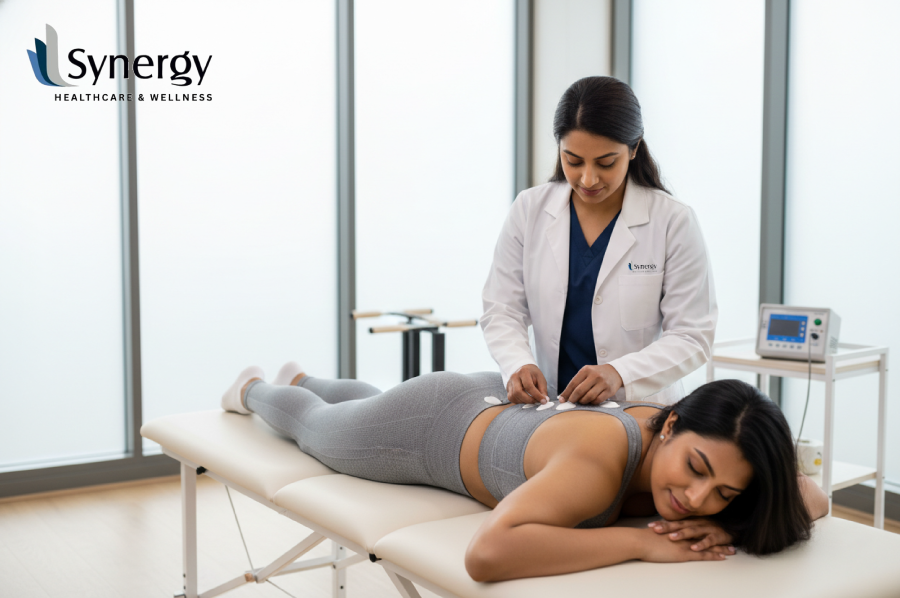
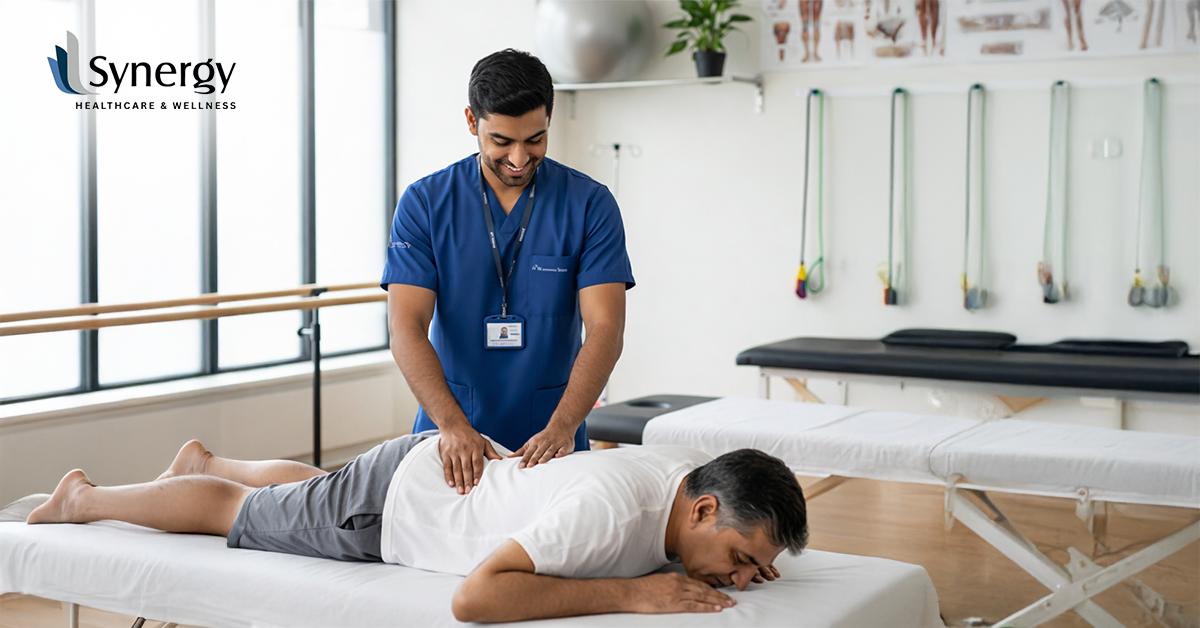
- Comprehensive Care: We combine the latest electrotherapy and corrective exercises with manual therapies like trigger point release to provide you with a full solution for a perfect recovery.
- Evidence-Based Practice: Our procedures are supported by the latest publications, thus ensuring that your rehabilitation is directed by data and not by a guess.
Important Parts of a Good Program
To be called “structured,” a program must have these four parts:
- Proprioception Training: Teaching the body again how to know where it is in space. This is an important step in making sure that the knees and ankles don’t get hurt again.
- Progressive Overload: Putting more stress on the body (through weight, number of repetitions, or speed) to help it adapt.
- Eccentric Loading: This is a very important part of adapting the tendon because it focuses on the “lengthening” part of a muscle contraction.
- Core Stability: Keeping the body’s “engine” stable so that the limbs can move freely.
Rehabilitation Comparison: Active vs. Passive Recovery
| Feature | Passive Rest (Traditional) | Structured Rehab (Synergy Approach) |
| Tissue Impact | Leads to muscle atrophy/stiffness. | Stimulates collagen and strength. |
| Recovery Speed | Slower; prone to “plateaus”. | Optimised via phased loading. |
| Reinjury Risk | High (due to lingering weakness). | Low (addresses biomechanical gaps). |
| Mental Health | Can lead to “fear of movement.” | Builds confidence via milestones. |
Take Charge of Your Recovery
Starting a rehab exercise programs are a way to invest in your future. There is a difference between feeling better and being structurally sound. If you follow a structured and professional process, you can avoid the problems and unknowns that come with trying to recover on your own.
Our goal at Synergy is to help you go from pain to performance. Our team-based care and rehabilitation programs are meant to help you get your energy and independence back. Don’t let an injury stop you from doing things; instead, use a plan to get past it.
Are you ready to start your own recovery process? Set up a meeting with Synergy today.
FAQs
1. How long does it usually take for a rehab exercise programs to work?
Pain relief may happen in 1 to 2 weeks, but it usually takes 4 to 8 weeks of consistent, structured work to improve function and strengthen tissue.
2. Are these exercises something I can do at home?
Yes, but only after a professional has shown you how to do it right. But the first classes at Synergy are very important to make sure that your exercises don’t make the injury worse by accident.
3. Is rehab just for athletes?
No way! Everyone, from office workers with neck pain to seniors who have fallen, can benefit from a structured rehabilitation program that helps them keep their quality of life.
4. What should I do if I feel pain while doing the exercises?
A structured program adheres to the “24-hour rule”—mild pain is anticipated; however, if pain intensifies or continues the following day, your therapist modifies the “load.”
5. How do I know when I’m ready to progress to the next phase?
Progression is based on clinical milestones (e.g., reaching a specific range of motion or strength score) rather than just a set number of days.
6. Do I need a doctor’s referral to start a program at Synergy?
There is no need for a referral; you can just book an assessment with one of our senior doctors and begin your treatment plan immediately.
7. Is it possible for me to work while doing a rehab exercise program?
Generally, yes. Most rehabilitation programs are set up so that one can still manage their daily routines. Your therapist might change some of the movements or your activity level so that you can continue working and at the same time not interfere with your recovery.
8. What is the difference between physiotherapy and a structured rehab exercise program?
Physiotherapy often includes manual therapy, pain relief modalities, and early-stage care. A structured rehab program goes further by systematically rebuilding strength, endurance, coordination, and functional capacity in progressive stages.
9. Will I lose improvements if I miss some sessions?
Normally, missing a session or two does not cause harm, but one should be consistent to get the best tissue adaptation. Very long breaks may delay collagen remodelling and neuromuscular retraining that can slow down the overall recovery process.
10. Are rehab programs adjusted for age and level of fitness?
Indeed. A well-thought-out program considers one’s age, medical records, previous activity levels, and the pattern of the specific injury. The way the body is loaded and how fast the program progresses are two aspects that are tailored to an individual’s capacity.