
Concise Overview
If you want to keep your quality of life high, you need to make long term pain prevention a top priority. Protect your muscles and joints with little changes to your regular routine, including sitting up straight, drinking enough water, and moving gently. If you want your body to be strong, mobile, and pain-free for years to come, Synergy can help you incorporate these adjustments easily.
Introduction: Why Your Habits Make a Difference: The Quiet Build-Up
Pain, whether it’s a jolt to the back from moving a heavy box or a shin splint from a long run, is usually seen as an abrupt occurrence. On the other hand, many of us have chronic pain due to “micro-traumas,” or little, repeated pressures brought on by our daily sitting, standing, and moving positions.
Just like a trickle of water from a tap won’t accomplish much at first, it might eventually overwhelm a sink. Physically, we are very similar. Even if it doesn’t hurt now, sitting for eight hours straight on a laptop or wearing shoes without arch support will eventually hurt. Guess what? Just as little bad behaviours add up to big problems, little good changes can contribute to long-term pain prevention and keep you moving freely for years to come.
This blog will teach you to recognise these subtle triggers and to protect your musculoskeletal health with simple, evidence-based treatments.
A Comprehensive Guide on the Mechanisms of Contemporary Pain
The “biopsychosocial” model is a popular one in the medical field when people talk about pain. Thus, your biological make-up (nerves and muscles), psychological make-up (stress levels), and social milieu (workspace arrangement) all have a role in determining your level of physical comfort.
Low back strain and “tech neck,” two of the most prevalent everyday aches, are caused by static loading. When we remain motionless for lengthy periods of time, our muscles get tired, and our ligaments and joints take the strain. These structures weren’t made to support such heavy loads for so long. This has the potential to cause degenerative alterations or chronic inflammation in the long run. The first step in finding relief from pain is realising that it is more often than not a message to “change something” rather than an indication of long-term harm.
5 Easy Habits for Long-Term Pain Prevention
1. The “Move Every 30” Principle
Moving about is fundamental to human anatomy. The importance of varying periods of inactivity on metabolic and skeletal health was highlighted in a recent study published in the British Journal of Sports Medicine.
Habit:
Establish a 30-minute timer as your habit. In response to its triggering, get to your feet, raise your arms high, or stroll for one minute.
Its effectiveness:
As a result, the spinal ligaments can stop “creeping”, and blood may once again reach compressed regions.
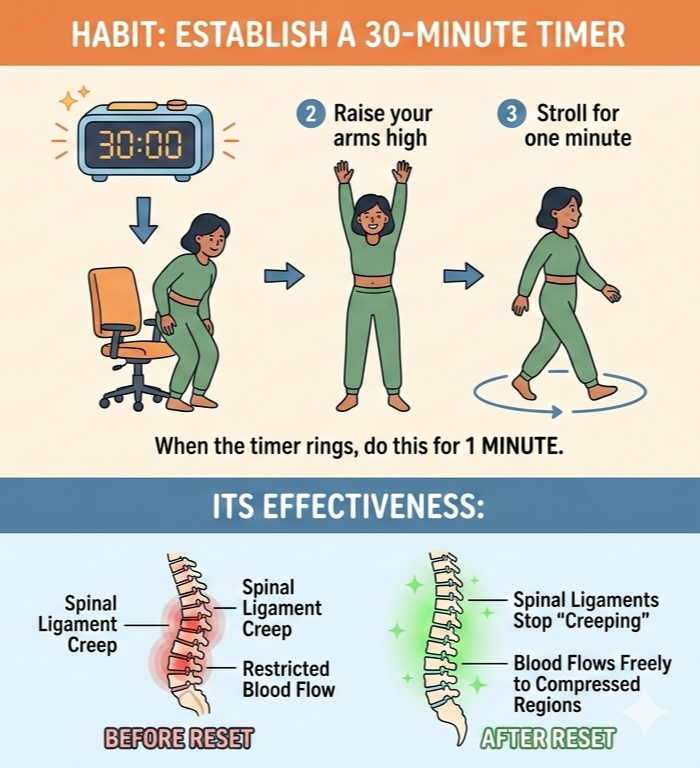
(“Move Every 30” principle, illustrating the immediate benefits of a quick movement break on spinal health and circulation.)
2. A Mindful Emphasis, Not a Stiff One
On the other hand, a “varied” posture is more accurate than a “perfect” posture. It can be equally taxing to sit up straight as it is to slouch.
The Ritual:
Sit with your feet flat on the floor and the screen at eye level. Inspect yourself from time to time to see whether your shoulders are sagging over your ears.
To learn more about ergonomic workstations, check out this blog provided by Synergy: Ergonomic Workstation Setup to Reduce Neck and Back Pain.
3. Fluids and Elasticity in Tissues
Water makes up the majority of your intervertebral discs, which act as cushions between your vertebrae in your spine. These discs can become thinner and less shock-absorbing as a result of dehydration.
Habit:
A water bottle should always be at hand at a desk. Instead of downing a whole litre in one sitting, try to spread your consumption out over the day.
A physiotherapist’s insight:
Tissues that are hydrated are less likely to strain because they may slide and glide more freely over one another.
4. Improvising the “Posterior Chain”
Typing, cooking, and driving occupy the vast majority of our waking hours. Because of this, our back muscles become weak, and our front muscles get tense.
Be sure to include some basic “pulling” or “glute bridges” exercises in your morning routine.
A natural spinal corset can help avoid back problems in the long run, so strengthening your glutes and back is a good place to start.
5. Improving Your Sleep and Recovering
When we don’t get enough sleep, our pain thresholds rise. The body’s production of growth hormones, which aid in tissue repair, occurs during deep sleep.
The Practice:
You should always check that your mattress can sustain your weight and the way you like to sleep. If you sleep on your side, a pillow between your knees might help keep your hips in a neutral position while you sleep.
How Diet Affects Joint Health and Lifespan?
Your body’s inflammatory indicators are greatly affected by your diet. You can keep your cartilage in good repair by eating foods high in antioxidants, collagen-supporting minerals, and Omega-3 fatty acids. Joint stiffness is a common symptom of chronic systemic inflammation; so, your food choices are an unsung but potent ally on your path to wellness.
Handling Repetitive Stress in the Era of Technology
Workers’ compensation claims involving repetitive stress injuries (RSIs) rank high. Overusing little muscle groups, such as those in the forearm or wrist, as happens with repeated clicking or typing, can lead to this condition. By incorporating ‘micro-breaks’ and making use of ergonomic tools, you can reorganise the mechanical stress onto bigger muscle groups.
Synergy Healthcare and Wellness’s Professionally Led Treatment Programs
Movement is medicine, according to Synergy. Structured, evidence-based approach defines our work as a specialised rehabilitation centre focused on clinical knowledge and patient confidence. Avoiding movement isn’t the key to pain prevention; rather, it’s learning to move more efficiently.
Our main focus is on helping you maintain proper alignment and functional strength, which can be beneficial for injury recovery or just to slow down the ageing process. To make long-term pain prevention a daily objective, our concept is centred on giving you the power to understand your individual biomechanics. Our senior doctors conduct initial patient assessments at all of our Chennai clinics (including T. Nagar, Anna Nagar, and Adyar) to identify the best course of treatment for each individual.
Our Reasons for Opting for a Multidisciplinary Strategy
To guarantee a quick and long-lasting recovery, we integrate cutting-edge medical technology with our professional hands. Among our staff are seasoned physiotherapists who have completed specialised training in robotic rehabilitation, dry needling, and manual therapy.
In order to improve your mobility and self-assurance, we do more than only treat symptoms; we also determine causes, such as deconditioning, workload, and movement habits. Synergy is a natural, non-invasive healing procedure that can reduce your need for medication in the long run.
When Should You Consult an Expert?
Although habits serve as a basis, there are instances when the body needs a “reset.” A trip to the doctor may be in order if you’re dealing with numbness, radiating pain, or aches that refuse to go away after a good night’s sleep.
Physiotherapy is a preventative measure as well as a tool for use after surgery. If you want to catch muscular imbalances before they cause injuries, a professional evaluation is your best bet.
At Synergy, we prioritise evidence-based recovery and long-term health. Our particular rehabilitation procedures and preventative care initiatives are available for you to explore.
Conclusion: Your Older Self Will Be Grateful to You
A complete change in lifestyle isn’t necessarily necessary to find relief. Between nine in the morning and five in the afternoon, it is in the subtle decisions we make.
You can invest in a future free of pain by increasing your water intake, increasing your movement frequency, and improving your posture somewhat.
Your body can adjust to a lot of different situations. Resilience is its reward for being in an ideal environment, which includes activity, relaxation, and correct alignment. Begin now with a single, manageable adjustment, and experience the immense relief that follows.
FAQ’s
1. How can I begin a program to reduce my discomfort over time without being overwhelmed?
You can begin with a simple activity, such as taking a walk each hour, and gradually move on to more complicated ones once the routine is in place.
2. Am I still a candidate for physiotherapy if I am not experiencing any pain at the moment?
Yes, physiotherapists can help identify potential trouble spots in your gait and develop a unique plan to keep you pain-free for the long haul!
3. Every morning when I wake up, why am I always stiff?
You can try light stretches and drink plenty of water to help alleviate morning stiffness, which is often caused by the lack of lubrication in the joints during the night.
4. Which chair is the most suitable for me if I need to work for long hours without any back pain?
You can identify the most appropriate chair for your needs through an ergonomic evaluation service, although in general, a chair that provides lower back support and allows you to sit with your knees slightly lower than your hips is recommended.
5. Can stress really make my shoulders hurt?
Tension headaches and long-term pain are real signs of stress, which makes the central nervous system tighten muscles, mostly in the neck and shoulders.
6. If you have muscle pain every day, would you suggest using ice or heat?
In general, heat is better than ice for stiff muscles because it increases blood flow. Ice is better for new injuries because it reduces swelling.
7. How often should I work out to make my joints healthier?
To keep joints lubricated and prevent pain in the long run, the NHS recommends at least 150 minutes of moderate movement every week.
8. Is it possible to correct years of slouching?
As the body is malleable, programs to strengthen the muscles in your upper back and to deliberately place your body in certain positions will work.
9. What happens if it is chilly, or it rains?
Tissues can expand and contract in reaction to changes in barometric pressure, which can worsen existing injuries or worsen particularly sensitive joints.
10. What can I do if changing these habits does not relieve my pain?
Expert examination at Synergy Physio is necessary if your discomfort has lasted longer than two weeks.