
Short Summary
Stop settling for “good enough” physical health. Movement dysfunction correction is the ultimate biological upgrade, identifying the hidden mechanical “glitches” that drain your energy and cause chronic pain. At Synergy, we use elite-level physiotherapy to retrain your nervous system, optimise your posture, and ensure your body performs with the precision and power of a fine-tuned machine every single day ahead.
Introduction: The Truth About Compensation
We’ve all experienced it: that “random” twinge in the lower back after a gym session, or the neck stiffness that sets in every Thursday afternoon. Most of us blame the chair or the weather. But the truth is more fascinating. Your body is a master of deception. When one part of you is weak or stiff, your brain doesn’t stop; it cheats. It “borrows” movement from another joint to get the job done.
This is called a compensation pattern. It’s a short-term survival win but a long-term structural disaster. Movement dysfunction correction isn’t just about feeling better; it’s about opening the bonnet of your biological machine, finding the misaligned belt, and fixing the engine before it smokes.
What Exactly is Movement Dysfunction?
Think of your body as a high-performance kinetic chain. In a perfect world, every link moves at the right time with the right intensity. Movement dysfunction occurs when the “software” (your nervous system) and the “hardware” (your muscles and joints) lose sync.
- The Glitch: A primary mover (like your glutes) goes “quiet” due to prolonged sitting.
- The Shift: A secondary muscle (like your lower back) is forced to do a job it wasn’t designed for.
- The Breakdown: This creates “micro-trauma” in the tissues, leading to inflammation and pain.
Medical research published in the Journal of Bodywork and Movement Therapies confirms that most non-traumatic injuries are actually “motor control” issues. Your brain is essentially running a buggy version of the “How to Move” software.
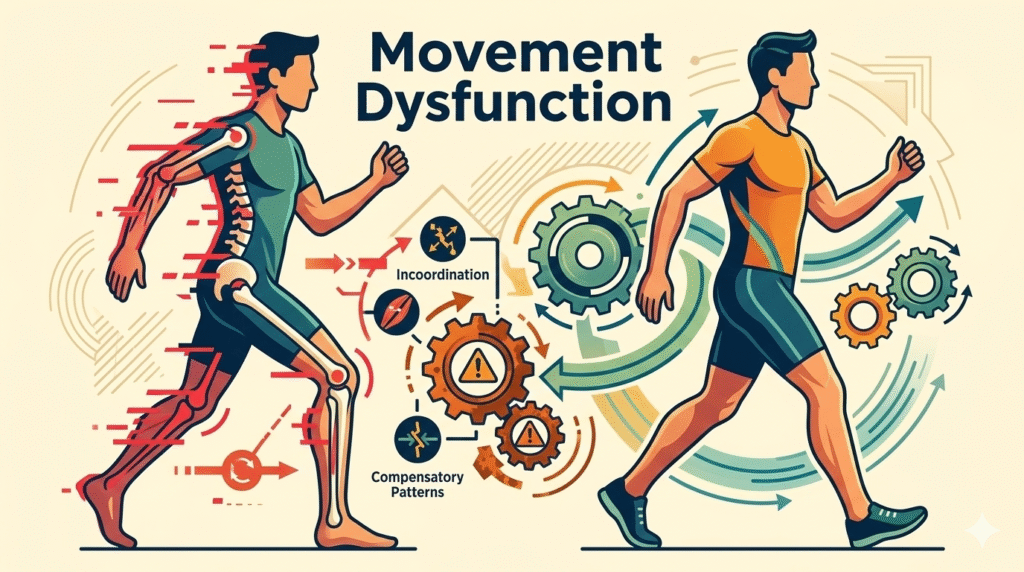
(This defines “Movement Dysfunction” by contrasting fluid, efficient movement on the left with restricted, “glitchy” mechanical movement on the right.)
The 4-Phase Protocol for Movement Dysfunction Correction
To rewrite years of faulty habits, we follow a rigorous, science-backed progression at Synergy Physio.
Phase 1: The Inhibitory Phase (The Reset)
We have to “quiet down” the muscles that are overworking. Using manual therapy and myofascial release, we hit the “mute” button on chronic tightness in the neck, hips, or calves.
Phase 2: The Activation Phase (The Spark)
Once the “noise” is gone, we wake up the dormant muscles. This involves specific, low-load exercises designed to re-establish the neural connection between your brain and your deep stabilising muscles.
Phase 3: The Integration Phase (The Bridge)
We take those “awake” muscles and put them to work in multi-joint patterns. We move from lying on a table to performing “Single-Leg Hinges” or “Thoracic Rotations”—the movements you actually use in real life.
Phase 4: The Resilience Phase (The Stress-Test)
Finally, we add speed, load, and fatigue. We ensure that when you are tired or under pressure, your body doesn’t revert to its old, clunky habits. This is where you become “injury-proof.”
Life Hacks for Better Biomechanics
You can start your movement dysfunction correction journey today with these “Movement Snacks”:
- The Anti-Gravity Reset: Every hour, stand against a wall with your heels, glutes, and head touching. Pull your shoulder blades down and back. Hold for 30 seconds to reverse “desk-slump.”
- The Tripod Foot: When standing, ensure your weight is evenly distributed between your big toe, little toe, and heel. This simple fix stabilises the entire kinetic chain up to your hip.
- Diaphragmatic Breathing: Shallow chest breathing tightens the neck. Breathing deep into your belly relaxes the nervous system and improves core pressure.
Your Weekly Movement Maintenance Plan
| Day | Priority | Exercise Focus |
| Mon/Wed | Mobility | “World’s Greatest Stretch” (Lunge with T-Spine rotation). |
| Tue/Thu | Stability | “Bird-Dogs” and Side Planks to link the core and limbs. |
| Fri/Sat | Load & Power | Squats or Deadlifts focusing on perfect hinge mechanics. |
| Sunday | Recovery | Low-intensity swimming or a long walk to flush tissues. |
Warning Signs: When to Call the Mechanics
Self-correction is vital, but some patterns require the clinical eye of a Synergy specialist. Consult us if:
- Your pain is “asymmetrical” (always on one side).
- You have “start-up” stiffness (pain when you first stand up).
- You have reached a training plateau where you can’t get stronger despite effort.
- You experience “clicking” or “clunking” in joints during routine movements.
As noted in the Archives of Physiotherapy, addressing movement impairments before they become painful is the most effective way to avoid long-term disability.
The Synergy Approach to Movement
At Synergy, we don’t just treat the pain; we also want to know what caused it. We believe that movement dysfunction correction requires a meticulous eye. At our clinics across Chennai—including Anna Nagar, Adyar, and T. Nagar—we ensure every patient undergoes a comprehensive functional movement screening. This allows our senior doctors to see exactly where your “link in the chain” is breaking. By combining manual therapy with precision exercise, we help you rewrite your body’s movement software.
Conclusion
Your body isn’t a static object; it’s a living, breathing project. In investing in correction of movement dysfunction, you’re investing in a future of high-level activity, not gradual decline. At Synergy, we offer the medical expertise to help you master your body mechanics and move with the grace and power you were born to do. Let’s stop managing your pain and start mastering your movement.
FAQs
1. How do I know if I need movement dysfunction correction?
If you find that you’re constantly “tight” in the same spot, or if your balance is off on one side, it’s time to seek professional movement dysfunction correction.
2. Can movement dysfunction correction help me run faster?
Yes, because by eliminating “braking forces” caused by poor alignment, you can ensure every ounce of your energy goes into forward propulsion through movement dysfunction correction.
3. Is this just another name for “stretching”?
Not at all; while stretching is part of it, movement dysfunction correction is a medical approach focused on how your brain coordinates muscle firing patterns for better stability.
4. How often should I practice these corrective exercises?
You will find that doing 5-10 minutes of movement dysfunction correction daily is far more effective for your nervous system than doing one long session once a week.
5. Can I fix movement dysfunction on my own?
While you can improve your habits, you need a Synergy expert to identify the subtle “blind spots” in your movement dysfunction correction that you cannot see for yourself.
6. Will this help with my chronic desk-job back pain?
Absolutely; most office-based pain is a direct result of the body adapting to a seated position, which movement dysfunction correction is specifically designed to reverse and fix.
7. Is it too late to start movement dysfunction correction if I’m older?
It is never too late; your nervous system remains “plastic,” meaning you can improve your movement dysfunction correction and overall agility at any age with the right guidance.
8. What is the difference between physical therapy and movement correction?
At Synergy, they are the same; we use clinical physiotherapy techniques as the foundation for achieving total movement dysfunction correction and long-term health.
9. Can shoes cause movement dysfunction?
Yes, if you wear poorly fitted or overly cushioned shoes, they can deaden the sensory feedback to your brain, necessitating movement dysfunction correction for your ankles and knees.
10. Why should I choose Synergy for my movement needs?
You should choose Synergy because they provide a bespoke, medically-backed roadmap for movement dysfunction correction that is tailored specifically to your unique lifestyle and performance goals.

Dr. Suresh Franklin, MPT
✓ 15+ Years of ExperienceMeet Dr. Suresh Franklin, MPT – the expert behind Synergy Physio Care's clinical approach. With extensive experience in sports rehabilitation, athlete recovery, and performance care, he brings trusted expertise to every piece of content we publish. From injury management to movement-based recovery, his review helps ensure our blogs are practical, accurate, and patient-focused. At Synergy, we combine clinical knowledge with real-world physiotherapy experience to guide every recovery journey.