A quick look:
Targeted gait training physiotherapy through physical therapy is an important treatment for people who are recovering from neurological disorders, injuries, or surgeries. This particular therapy aids individuals in walking more effectively by realigning their biomechanics, fortifying their muscles, and leveraging neuroplasticity. Structured, evidence-based clinical rehabilitation programs make patients much more independent, help them keep their balance, and lower their risk of falling.
The Science of Getting Back to Your Natural Gait: An Introduction to the Reclaiming Movement
Many of us don’t realise how complicated the physiological process of walking is until it stops working properly. It can be very limiting when you can’t walk normally, whether it’s because of an injury, a joint replacement, or a neurological event. But you know what? The body is great at learning and changing. Gait training physiotherapy helps people with physical limitations get better by focusing on the complicated mechanics of walking.
For a successful recovery, you need to learn how to stabilise your core, evenly distribute your weight, and keep your joints moving at the right speed. This special kind of rehabilitation does more than just “teach” you how to walk again. It changes the way you walk so that it is safer, more effective, and lasts longer. When therapists treat the underlying causes of a patient’s abnormal gait, such as weak muscles or sensory deficits, the patient can walk more confidently and with less pain.
1. The Biomechanics of Gait: What Makes Us Walk in Gait Training Physiotherapy?
The stance and swing phases are the two most important parts of a healthy walking cycle. Damage often causes these phases to be uneven.
- The first step, the Stance Phase, is to put your foot firmly on the ground. Common signs of problems here are not being able to “push off” through the toes or not being able to bear weight.
- The foot moves forward during the swing phase. A “foot drop” or dragging gait is a common sign of problems here.
- “Double Support” is the split second when both feet are flat on the floor. To stop falls, this phase needs to be more stable.
2. Neuroplasticity and Functional Retraining
Neuroplasticity, the brain’s ability to make new connections between neurones, is a fascinating part of physiotherapy for gait training. Training that is both hard and specific to a task can “rewire” the brain to use different pathways to control leg movements when a normal pathway is broken.
- Repetitive movement patterns help build muscle memory.
- Feedback: Physiotherapists use both verbal and visual cues to quickly correct posture.
- Proprioception: When you walk on uneven ground, you need to be more aware of where your limbs are in relation to each other in space. Certain exercises can help with this.
Clinical Gait Training vs. Regular Exercise
| Part | Full Physical Therapy | Rehabilitation for a Bad Walk |
| Listen up | Strength and flexibility as a whole | Information about how gait works and how stable it is |
| Tools | Masseuse and exercise equipment | Treadmills, parallel bars, and harness systems |
| Aim | Less pain and better overall health | Symmetry in stance and freedom of movement |
| The result | A body that is more toned | A way of walking that is both safe and effective |
3. Important Tools and Methods for Rehabilitation
Modern gait rehabilitation uses a number of scientifically backed methods to speed up the healing process.
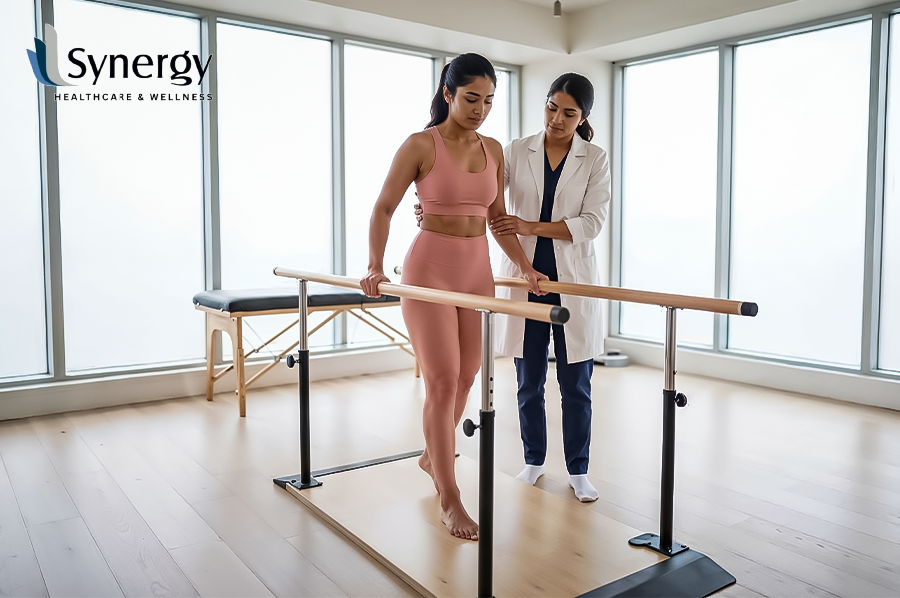
- A set of parallel bars might be a good place to start if you want to learn how to balance and carry weight.
- Body Weight Support (BWS): Patients can practise walking movements without the full force of gravity because harness devices take the weight off their joints.
- Functional electrical stimulation (FES) can make the toe-lifting muscles work by sending small electrical pulses to them.
- Training on a treadmill: Getting started on the road to recovery can be hard, so this kind of exercise encourages a steady, rhythmic gait that is easier to do on a treadmill.
(Alt Text :A shot of a female patient using parallel bars for support in a rehabilitation gym, while a male physiotherapist kneels beside her to guide her stepping technique.)
4. Taking a Stand Against Bad Balance and Falling
Mental health is a big part of getting better at walking. A rigid stride or “short-stepping” could make it more likely that someone will trip because it makes them less mobile. Clinical studies published on PubMed show that gait therapies that focus on keeping a steady balance can greatly lower the number of falls among older people and people who are recovering from surgery. According to the Chartered Society of Physiotherapy, early movement can help prevent long-term effects like joint stiffness and muscle atrophy.
5. Moving to Mobility in the Real World
The goal of every clinical program is to get people out of the gym and onto the street. Part of this process is learning “community ambulation,” which includes things like walking on grass, using curbs, and going up and down stairs. Physiotherapists focus on “dual-tasking” to get their patients ready for the multi-sensory world of everyday life. This means doing two things at once, like walking while holding something or talking.
Synergy Physiotherapy: A Place for Clinical Excellence
Many clinics offer general help, but real rehabilitation needs a high level of biomechanical accuracy. The main idea behind Synergy is that cutting-edge technology and real-world clinical knowledge work together. Digital gait analysis is an important part of our physiotherapy strategy for gait training. This ensures that your musculoskeletal system is always supported whenever you make any step.
We work with people who have difficulties in movement and restore their abilities through comprehensive physical rehabilitation coupled with therapeutic techniques that benefit them. It may be either after undergoing a minor surgery or due to some lifelong problems related to movement. In both cases, we always strive to bring back your “bounce.” This is what we aim for when conducting rehabilitation programs at Synergy – to ensure that people walk in a healthy manner, which is a key characteristic of a youth lifestyle.
You can read our previous article on Small Changes, Big Relief: Simple Habits for Long-Term Pain Prevention in Daily Life to understand how everyday routines can have a powerful impact on your physical health.
Conclusion: Consistency is the Key to Recovery
You need to be careful if you want to get back on your feet. When you do a gait training physiotherapy program, you do more than just move your legs. You also need to reconnect the complicated network that links your brain, muscles, and surroundings.
Two of the most important things you can have are patience and determination. You can learn to walk without help if you get the right medical advice and pay attention to how your body moves. A medically-informed plan makes every step toward a more mobile future possible, whether you want to get back to the golf course or just enjoy walking around your garden.
FAQ’S
1. How long does it usually take to be able to walk again?
Most people say that after four to six weeks of regular treatment, their balance and coordination get better, but results may vary from person to person.
2. Is the physical therapy for gait training painful?
When your therapist works with you, they will always think about how comfortable you are. You shouldn’t feel any pain, but you should feel your muscles working hard.
3. Is it possible for me to do these workouts at home?
You should always practise in a safe, clean place to avoid falling, but you shouldn’t do it until your therapist says it’s okay.
4. Can this treatment help an old injury that has left you with a “limp”?
Yes, for sure! If you’ve developed bad habits over time, specialised gait training physiotherapy can help you fix them.
5. Do you need a doctor’s note to get gait training?
You can usually refer yourself, but if you have any serious health problems already, it’s best to see your doctor first.
6. What should I wear to my physical therapy sessions?
The best clothes to wear are loose and comfortable, like what you would wear for a walk outside.
7. Does gait training help people who have had a stroke or have Parkinson’s disease get better?
Using rhythmic cues and neuro-rehabilitation methods is the best way to control these specific neurological gait problems.
8. Can older people get better from this treatment?
You should think of it as your main tool for staying independent and avoiding injuries to your hips or knees because it is so useful.
9. Could gait training help with joint pain?
If you work on your alignment, your lower back, knees, and hips should feel less “wear and tear.”
10. What is the first thing you do when you start a gait program?
A doctor should film how you walk and then do a full gait analysis to find your weak spots.

Dr. Suresh Franklin, MPT
✓ 15+ Years of ExperienceMeet Dr. Suresh Franklin, MPT – the expert behind Synergy Physio Care's clinical approach. With extensive experience in sports rehabilitation, athlete recovery, and performance care, he brings trusted expertise to every piece of content we publish. From injury management to movement-based recovery, his review helps ensure our blogs are practical, accurate, and patient-focused. At Synergy, we combine clinical knowledge with real-world physiotherapy experience to guide every recovery journey.