Epicondylitis is a common source of chronic forearm pain. Tennis elbow is an injury to the outside of the elbow tendon, and golfer’s elbow is an injury to the inside of the elbow tendon. Treatment for this structural strain is targeted rest and specific loading exercises, together with evidence-based clinical rehabilitation. This blog outlines the symptoms, biomechanical causes and clinical interventions, including home elbow pain treatment at home to restore painless upper limb mobility.
Intro: Hidden Causes Behind Tennis and Golfers Elbow in Daily Life
Repetitive forearm rotation, heavy lifting and poor wrist mechanics place excessive stress on the tendons that attach to the elbow joint. These injuries are medically known as lateral epicondylitis (tennis elbow) and medial epicondylitis (golfers elbow). The names sound athletic, but the conditions are experienced mostly by people doing routine manual labour, office work or repetitive industrial tasks. The key to selecting the right path to recovery is understanding how these conditions come about. Many mild or early-stage tendon strains can be treated at home with targeted elbow pain treatment at home. Chronic or serious cases require professional evaluation to avoid permanent degeneration of tissue.
Tennis Elbow vs. Golfer’s Elbow: What’s the Difference?
In order to properly treat upper limb pain, you need to first identify what tendon structures are involved. The elbow joint is the point of attachment for the muscles that move the wrist and fingers. These are the dissimilarities in the structure of these two diseases:
| Aspect | Tennis Elbow (Lateral Epicondylitis) | Golfer’s Elbow (Medial Epicondylitis) |
| Primary Area (Located Anatomically) | Lateral epicondyle (Outer part of the elbow). | Medial epicond (Inner part of the elbow). |
| Group of Affected Tendons | Extensor carpi radialis (Common extensor tendon). | Flexor carpi ulnaris (Wrist flexors and pronators). |
| Aggravating Movements | Lifting objects with palms down, typing, and turning doorknobs. | Gripping tight, wrist bending, crushing and throwing. |
| Radiation pathway of pain | Radiates down the back of the forearm into the wrist. | Radiates down inside the forearm towards the ring finger and pinky. |
Key Symptoms and Red-Flag Signs
The recognition of early signs of epicondylitis prevents acute tendon irritation from evolving into chronic tendinopathy. Both conditions cause localised joint soreness, but their patterns of diagnosis are different.
Symptoms of Tennis Elbow
- A dull ache at the bony bump on the outside of your elbow.
- Sharp pain in the wrist or fingers when stretched against resistance.
- A noticeable loss of grip strength, causing you to drop lightweight objects such as cups or books.
- Morning stiffness of the elbow joint and forearm muscles.
Golfers Elbow Symptoms
- Tenderness with localised swelling on the inner bony prominence of the arm.
- The pain was worse when shaking hands, flexing the wrist downwards, or squeezing a ball.
- Compression or irritation of the ulnar nerve may lead to altered sensation, including tingling and numbness in the fourth and fifth digits.
- Stiffness that goes from the elbow down the medial forearm.
Daily Biomechanical Triggers & Root Causes
Tendons are much less vascularised than muscles, and therefore very prone to micro-tearing when subjected to sudden overload or repetitive mechanical stress.
- Occupational Overuse: Individuals with repetitive wrist movements, like professional content writers, assembly line workers, carpenters, painters, and cooks, are at a high risk.
- Faulty Sports Technique: A faulty grip on a tennis racket, hitting mechanics that are too wrist-dominant or a faulty golf swing path can all put uneven force on the tendons of the elbow.
- Sudden Mechanical Overload: Micro-tears in the tendon fibres can happen instantly if you lift a heavy object (like a piece of luggage or gym equipment) with your arms in the wrong position.
- Poor Ergonomic Workstations: Typing for long periods on a flat keyboard without proper forearm support can compress and strain the wrist extensor tendons over time.
Evidence-Based Self-Care for Successful Treatment of Elbow Pain at Home
In mild cases, you can reduce inflammation and start tissue repair by following a structured routine of elbow pain treatment at home.
1. The POLICE Protocol
Modern sports medicine has moved away from absolute rest and recommends the POLICE protocol for early tendon management:
- Protect: A counterforce brace 2 inches below the elbow will protect the joint from further stress.
- Optimal Loading: Move freely and pain-free to keep your blood flowing and your joints mobile.
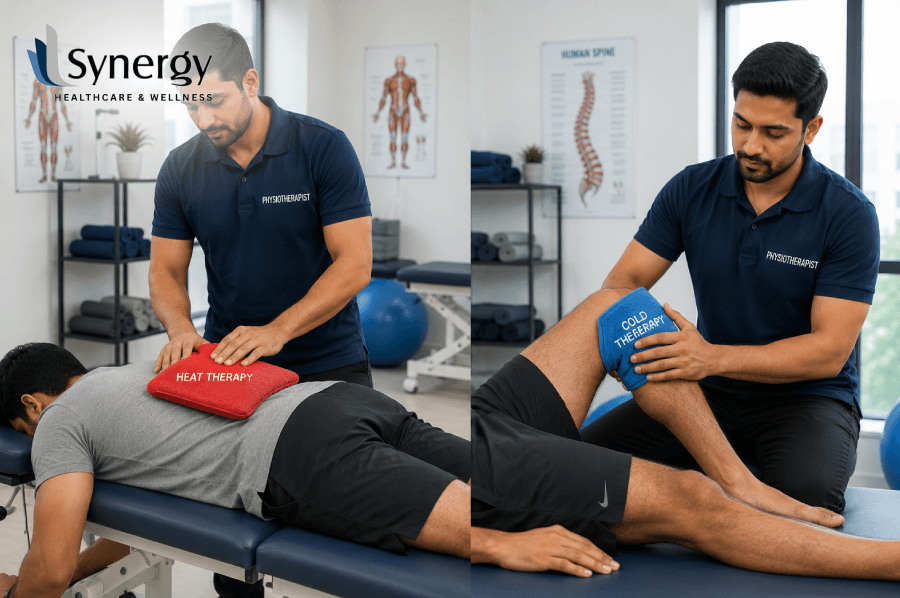
- Ice: Apply a cold pack encased in a towel for 15 minutes, 3 times a day. This will dull down any sharp neural pain.
- Compression: Compression is done using a soft elastic bandage.
- Elevation: While resting, the arm must be comfortably elevated above the level of the heart using a pillow.
2. Exercises To Be Done At Home
Following the resolution of pain, progressive overload is used to recondition the tendons:
- Eccentric Wrist Extensor Strength Exercises: Sitting in a chair with the forearm supported by the thigh, use an extremely light weight and keep the palm downwards. Using your other hand, lift the weight and then gently lower it down while counting to five seconds.
- Passive Forearm Stretch: Extend your injured arm straight in front of you with the palm facing down. Using your other hand, gently pull your fingers toward your body until you feel a comfortable stretch across the top of your forearm. Hold for 30 seconds.
Treatment Procedures
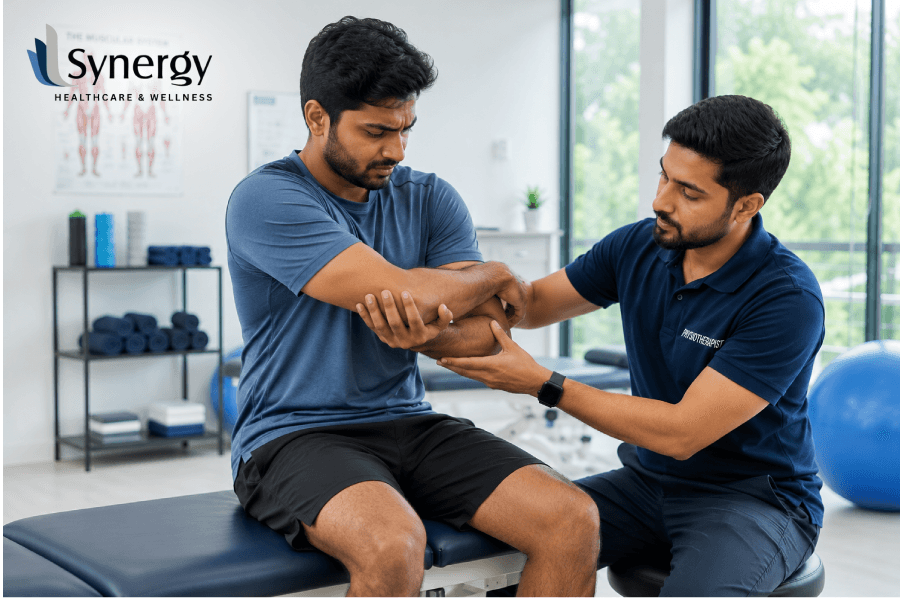
- Hands-on Structural Manipulation – Manual Therapy and Joint Mobilisation: The manipulation of structures in order to ease tissue tension and extend the physiological range of motion.
- Dry Needling and Trigger Points Therapy: Needles are inserted into tight muscles to relieve the pain associated with spasms and improve blood circulation.
- Kinesio Taping: Application of elastic tape for relieving pressure on the underlying tissues and reducing inflammation.
- Strengthening Regimens: Structured and supervised exercises gradually stress the affected tendons to regain their strength and avoid future injuries.
Are you dealing with pain in multiple locations? Do you need help with your chronic pain? Read more about how we use advanced treatments for chronic pain to recover naturally through physiotherapy.
Synergy Healthcare Comprehensive Care
If home management does not provide long-term relief, then clinical intervention is required to address deep tissue degeneration. Synergy Healthcare’s senior consultants provide a high level of evidence-based physiotherapy specific to your biomechanical needs. Instead of just covering up pain, clinical protocols aim at structural alignment, tissue regeneration and long-term joint health.
Our clinical teams in Anna Nagar, T. Nagar, Adyar, Mogappair and Vepery use advanced diagnostic techniques to distinguish between simple tendon strain, nerve entrapment and ligament laxity. We determine the precise time of injury and tailor rehabilitation exercises that ensure permanent effects.
Final Thoughts on Dealing with Joint Strain
Treating ongoing upper limb discomfort requires a combination of proactive home elbow pain treatment at home and expert clinical advice. If you disregard early symptoms like a weak grip or tenderness in the inner joint, you can develop chronic tendinopathy from a simple strain. You’ll have a definitive diagnosis and a clear plan for recovery when you work with the expert team at Synergy. Acting quickly preserves the health of your tendons, regains your physical strength and allows you to continue comfortably in your daily life.
| Take control of your recovery today with expert guidance from Synergy and restore your strength with confidence and precision. |
FAQs
1. How long does golfers elbow take to heal completely with home care?
Symptoms generally subside within 4 to 6 weeks with home care and rest, but chronic tendon problems can take several months to fully recover, with structured physical therapy. Getting some early rest and loading is important for faster tendon healing.
2. If I am diagnosed with tennis elbow, can I keep weight lifting?
During the acute painful phase, no heavy lifting should be performed, as pushing through the sharp pain can exacerbate the micro-tears in the tendon and increase overall recovery time. Normal, safer movements are modified or pain-free in the early stages of healing.
3. Why do I have pain on the inside of my elbow when I am not playing golf?
Everyday activities like lifting bags, typing or using poor wrist alignment place the same mechanical stress on inner elbow tendons as a golf swing. More often than not, repetitive daily strain contributes more than sports activity alone.
4. Do I use a heating pad or an ice pack for acute tendon pain?
Generally, ice packs are recommended for 48 to 72 hours to help reduce acute inflammation. Heat pads are more useful later, to relax stiff muscles before stretching. Alternating methods may have the right intensity for an optimal enhanced recovery.
5. Will the counterforce brace be effective against epicondylitis?
The purpose of the counterforce brace is to take off load from the tendon insertion point and spread out mechanical loads across the arm. The counterforce brace will be most effective in combination with rest and exercise.
6. What will happen if I neglect the pain in my forearm tendon?
Neglecting this condition may result in developing chronic tendinosis, weakened gripping force, and micro-tears in the tendons. Proper intervention in time will prevent the development of functional problems.
7. Are there any wrong ergonomics at my desk because of the outer elbow pain?
Most cases of outer elbow strain are associated with typing without supporting your forearms, which leads to the constant strain of your wrist extensor muscles. Proper ergonomics at your desk will prevent further symptom development.
8. How does a nerve problem differ from a tendon injury?
Tender burning, tingling, or numbness in the fingers indicates a nerve compression disorder, while localised pain occurring during movements is indicative of a problem with the tendons. The clinical examination will establish the cause.
9. Can I do stretching exercises when my arm hurts in the morning?
Stretching exercises of the warm arm are recommended, since they will help to alleviate the pain without injury to the tendon. Forceful stretching can only delay recovery. Gentle and consistent movement throughout the day can improve flexibility and reduce morning stiffness over time.
10. When should I stop doing self-treatment?
When pain persists after resting for more than two weeks or hand grip power decreases, you should see a doctor. It is likely that your tendon injury is in its advanced stage. Early clinical evaluation can help prevent further tendon degeneration and support faster functional recovery.

Dr. Suresh Franklin, MPT
✓ 15+ Years of ExperienceMeet Dr. Suresh Franklin, MPT – the expert behind Synergy Physio Care's clinical approach. With extensive experience in sports rehabilitation, athlete recovery, and performance care, he brings trusted expertise to every piece of content we publish. From injury management to movement-based recovery, his review helps ensure our blogs are practical, accurate, and patient-focused. At Synergy, we combine clinical knowledge with real-world physiotherapy experience to guide every recovery journey.