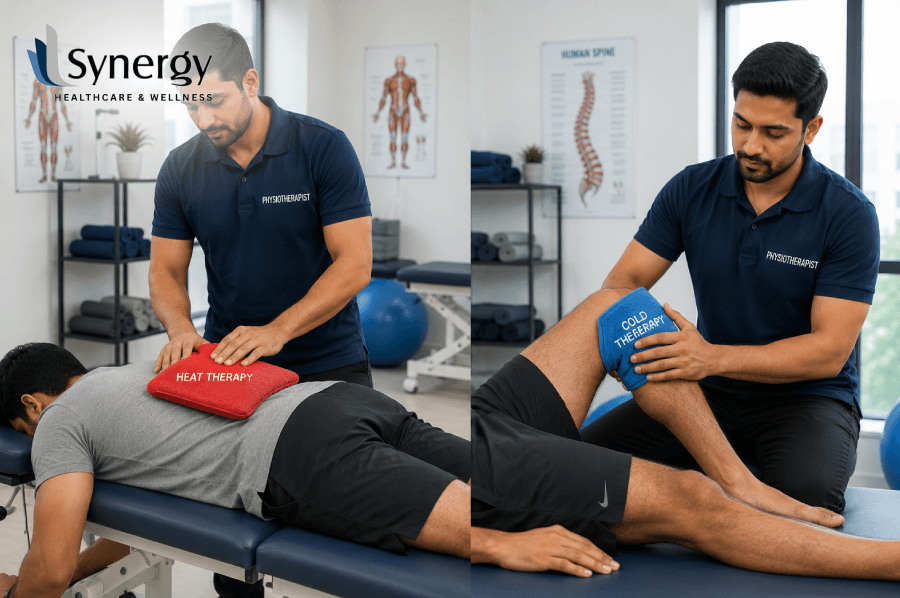

Wondering why your tailbone hurts without an injury? Tailbone pain can result from prolonged sitting, poor posture, arthritis, muscle strain, or cysts. Expert physiotherapy at Synergy Healthcare and Wellness helps relieve pain, improve mobility, and restore everyday comfort.
Introduction: Finding the Real Causes of Tailbone Pain
Coccyx pain, or tailbone pain, is much more common than most people think, and it isn’t always caused by a fall or an accident. Many people look for tailbone pain causes simply because their discomfort appeared out of nowhere, and they can’t recall any knock or trauma. If you’ve ever asked yourself what causes tailbone pain without injury, you’re not alone – everyday habits, underlying joint changes, and even some medical conditions can quietly trigger pain at the base of the spine.
Knowing how the coccyx works, recognising both common and hidden causes of pain, identifying symptoms that need medical attention, and understanding how personalised physiotherapy can support recovery are essential steps towards lasting relief.
What Is the Coccyx? A Quick Anatomy Refresher
Your coccyx is located at the very bottom of your spine, below your sacrum, and typically consists of three to five small, fused bones. The coccyx is made up of three to five fused vertebrae that support the spine. The coccyx is attached to the sacrum by strong ligaments and is directly attached to several pelvic floor muscles. This is why problems with the coccyx can sometimes affect comfort with the bladder, bowels, or even sex.
The tailbone is particularly prone to irritation, even without a single dramatic injury, due to its position, bearing pressure every time you sit, lean back or shift your weight.
What Causes Tailbone Pain Without Injury?
The classic triggers are a backward fall or childbirth, but a large share of coccydynia cases develops gradually. Understanding what causes tailbone pain without injury can help you get on the right path to treatment sooner.
1. Sitting for a Long Time or Bad Posture
Sitting for long periods, particularly in a hard, narrow or non-supporting chair, places continuous pressure on the coccyx. Slouching or leaning back puts additional pressure on this tiny bone, thereby gradually causing inflammation of the ligaments and joints in this area.
2. Ageing and Degenerative Joint Changes
The small joints that link the coccyx to the sacrum can stiffen, fuse or deteriorate as we age. Sacrococcygeal and intracoccygeal joints undergo degenerative changes and fusion that increase with age, which explains why coccydynia can develop slowly, rather than following a single occurrence.
3. Arthritis
Rarer than ankylosing spondylitis, rheumatoid arthritis can also affect the small joints near the tailbone. This causes stiffness and inflammation, with a dull, constant ache that gets worse with sitting.
4. Pilonidal Cysts and Local Infection
A cyst or small abscess forming near the tailbone, frequently due to ingrown hairs in this region, can lead to localised swelling, tenderness and discomfort similar to coccydynia.
5. Coccyx Hyper-Mobility or Instability
Some people have a more mobile coccyx or a coccyx that has subluxated slightly out of position naturally. This instability can cause pain from movement alone, without any outside trauma.
6. Musculoskeletal and Postural Misalignment
A compromised or constricted pelvic floor or gluteal muscles affect the weight-bearing of the body while sitting or standing; hence, there will be indirect pressure on the coccyx.
7. Referred Pain in the Lower Back
Sometimes the pain may actually be coming from the lumbar spine and not the coccyx itself. Disc problems in the low back can refer pain down to the tailbone region, making self-diagnosis difficult.
8. Idiopathic Causes
There are some cases of coccydynia that have no cause that doctors can identify, and they are classified as idiopathic even with thorough assessment.
9. Uncommon but Serious Causes
Tumours can cause chronic tailbone pain, though it is uncommon. Coccyx pain can also be a result of specific medical procedures, such as a colonoscopy. They are uncommon, but if the pain is severe or persistent, it is worth excluding them.
What Causes Tailbone Pain? At a Glance
| Cause Classification | Average Trigger | Pattern of onset |
| Posture stress | Long periods of sitting, hard surfaces | One step at a time |
| Degenerative changes | Ageing, Joint Wear | Slow |
| Arthritis. | Inflammatory or degenerative arthritis | Slowly, different |
| Pilonidal cyst/infection. | Local infection, ingrown hair | Localised and sudden |
| Hypermobility of coccyx | Structural joint instability | Variable > |
| Referred pain in the lower back | Lumbar Disc Problems | Gradual, |
| Idiopathic | No apparent trigger. | Variable |
| Tumour or serious pathology | Underlying pathological process | Getting worse and continuing |
When to Visit a Doctor?
Most coccydynia settles with home care, but you should seek medical advice quickly if you notice:
- Numbness or tingling that radiates into the leg or groin
- New problems with bladder or bowel control
- Visible lump, swelling or discharge near tailbone
- Pain that gets steadily worse instead of better
- Coccyx pain and fever
The clinician will usually take a detailed history and examine the area and may order imaging such as an X-ray, CT or MRI scan to rule out fractures, infection or other underlying pathology.
Physiotherapy Techniques to Help Treat Coccydynia
Manual Therapy
Gentle mobilisation of the sacrococcygeal joint and surrounding soft tissue to relieve stiffness and irritation.
Want to learn more about how manual therapy helps relieve pain and improve mobility? Read our detailed guide: Top Manual Therapy Techniques Used for Pain Relief and Recovery.
Postural Retraining
Sitting in a way that distributes weight evenly without bearing it all on the tailbone.
Exercise for Coccyx Stability
Exercises that one can undertake to ensure stability of the coccyx during movement.
Advice on Graded Activity
Gradually start cycling, driving, or sitting.
Self-care Tips During Your Recovery Period
- Lean forward, not backward
- Get up and stand for a few minutes after 30-40 minutes
- Sit on a wedge or coccyx-relief cushion on hard chairs.
- Apply heat or ice to the area for immediate relief.
- Don’t cycle or ride a horse at high impact until the pain has eased.
Synergy’s Approach to Tailbone Pain
At Synergy, all patients with tailbone pain get a comprehensive assessment done by senior doctors before any physiotherapy is scheduled. This ensures that the actual pain origin is correctly identified, which can be postural, degenerative or referred pain from the lower back. The Synergy team’s approach to chronic pain conditions across its clinics in Chennai, Anna Nagar, T. Nagar, Adyar, Mogappair and Vepery is based on this systematic, evidence-based approach.
Once assessed, the physiotherapy team at Synergy will devise a plan specific to your condition. This may include manual therapy to relieve stiffness around the sacrococcygeal joint, targeted core and pelvic floor strengthening to improve weight distribution whilst seated, and postural correction to reduce ongoing pressure on the coccyx. Synergy also offers home-based and online physiotherapy sessions for patients who are unable to travel so their recovery routines remain consistent and do not interrupt their daily lives.
Conclusion: Get Your Tailbone Pain Triggers Sorted at Synergy
You don’t need a dramatic fall to develop tailbone pain. Common tailbone pain causes that develop quietly over time include everyday habits, joint changes, and hidden conditions. If you’re wondering what causes tailbone pain without injury, the answer often lies in posture, muscle imbalances, degenerative changes, or referred pain rather than a single traumatic event. Whether it’s changing the way you sit, strengthening supporting muscles or seeking a professional assessment, identifying the cause is key. A team like Synergy Healthcare and Wellness can guide you through physiotherapy to find lasting relief without the need for surgery in most cases.
| Don’t let ongoing coccyx pain keep you from living your life comfortably – book your personalised assessment with the experts at Synergy today. Our team of dedicated physiotherapists will attack your pain at its source and help you sit, move and thrive pain-free! |
FAQs
1. What are the most common causes of tailbone pain?
Common causes are long sitting, poor posture, degenerative changes in the joints, arthritis and pilonidal cysts. Chronic repetitive stress from activities such as cycling can also overstretch the sacrococcygeal ligaments. The wear and tear gradually causes serious local inflammation and pain with normal weight.
2. What causes tailbone pain if there is no injury?
It’s often due to postural strain, ageing joints, muscle imbalance or referred pain from the lower back rather than one traumatic event. Physically, the coccyx can also be pulled constantly by hypertonicity (excessive tightness) of the deep pelvic floor muscles. Localised muscular tightness over time mimics a severe bone injury even if you’ve never fallen.
3. Is it true that sitting too long causes tailbone pain?
Yes, sitting on hard or narrow surfaces for long periods puts continuous pressure on the coccyx, gradually inflaming nearby ligaments. When you lean back in a chair, you’re really shifting the entire weight of your upper body straight off your glutes and onto the delicate tailbone structure. This repetitive microtrauma causes the local circulation to become compromised and results in deep, throbbing bone aches.
4. Do women suffer more tailbone pain?
Yes, women are much more likely to be affected than men, primarily due to pelvic anatomy and the stress of childbirth. Women possess a wider, more prominent pelvis, which leaves the coccyx more exposed to direct friction from the surface when seated. The pregnancy hormones also soften the ligaments that support this joint. This means the joint is less stable already.
5. Can arthritis cause pain in the tailbone?
Yes, the little joints near the coccyx can be affected by osteoarthritis and rheumatoid arthritis, leading to stiffness and aching. As we age, the cartilage that protects these little vertebrae wears away, and a little bone-on-bone rubbing begins. This degenerative process causes localised swelling and chronic pain that worsens with periods of stillness.
6. How long does tailbone pain last?
Most mild cases will resolve with rest, posture adjustment and supportive padding within a few weeks, although chronic cases may require extended treatment. If the cause is a deep structural misalignment or chronic muscle spasms, it may stubbornly linger for several months. By intervening early and in a targeted manner, you prevent the condition from settling into a long-term pattern of chronic pain.
7. When to get emergency care for tailbone pain?
You need urgent care if you have numbness, bowel or bladder changes, fever, or a lump near the tailbone that is rapidly getting worse. These red flag symptoms in particular may suggest deep pelvic infection, severe neurological compression or abscess formation. In such rare instances, prompt medical screening is essential for the protection of your overall health.
8. Can physiotherapy cure tailbone pain?
Yes, physiotherapy that focuses on posture, pelvic floor strength and joint mobility is a top non-surgical option for long-lasting relief. “Gentle manual therapy and specific mobilisation techniques are designed to return the sacrococcygeal joint to its natural, pain-free alignment if it is immobile.” It also addresses surrounding soft tissue triggers and resolves approximately 90% of non-traumatic cases without invasive measures.
9. Do cushions relieve tailbone pain?
Cushions that are wedge-shaped or have a coccyx cutout tend to be favoured as a treatment modality in providing relief through taking off the pressure applied to the tailbone. These cushions differ from the standard cushion or doughnut seat in that they have a cutout that will suspend your coccyx in the air.
10. Is a scan required to diagnose tailbone pain?
Not always, but if symptoms persist or if the doctor suspects a fracture, infection or tumour, they may call for an X-ray, CT or MRI. X-ray images obtained in motion, both standing and sitting, are especially useful for measuring the extent of tailbone movement under structural loads. In most non-traumatic cases, however, a thorough physical examination by an experienced practitioner is usually sufficient to begin treatment.

Dr. Suresh Franklin, MPT
✓ 15+ Years of ExperienceMeet Dr. Suresh Franklin, MPT – the expert behind Synergy Physio Care's clinical approach. With extensive experience in sports rehabilitation, athlete recovery, and performance care, he brings trusted expertise to every piece of content we publish. From injury management to movement-based recovery, his review helps ensure our blogs are practical, accurate, and patient-focused. At Synergy, we combine clinical knowledge with real-world physiotherapy experience to guide every recovery journey.